QN, RP, TS, WW, __, FH
2023
QN, RP, TS, WW, __, FH
Answer: C. AB — Each term in this series is a pair of letters. Treat the two letters as two separate, independent sequences — one for the first letter of every term, one for…
- A.
AC
- B.
XB
- C.
AB
- D.
YC
Attempted by 23 students.
Show answer & explanation
Correct answer: C
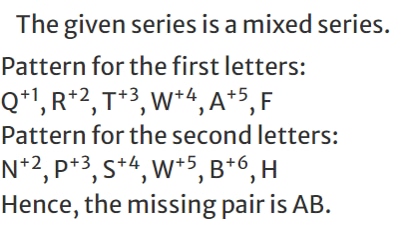
Each term in this series is a pair of letters. Treat the two letters as two separate, independent sequences — one for the first letter of every term, one for the second letter of every term. In each sequence, the letter advances by a gap (number of alphabet positions) that itself grows by exactly one position every step. If a position number goes past 26, wrap around by subtracting 26 (so the sequence continues from A again).
Convert every term into alphabet positions (A = 1, …, Z = 26): QN → (17, 14), RP → (18, 16), TS → (20, 19), WW → (23, 23), the missing term → (?, ?), FH → (6, 8).
First-letter positions across the terms are 17, 18, 20, 23. The gaps between consecutive terms are +1, +2, +3 — each gap is one more than the last, so the next gap (into the missing term) must be +4.
Apply that gap to the fourth term's first letter: 23 + 4 = 27. Since 27 exceeds 26, wrap around: 27 − 26 = 1, which is the letter A.
Second-letter positions across the terms are 14, 16, 19, 23. The gaps between consecutive terms are +2, +3, +4 — again each gap is one more than the last, so the next gap must be +5.
Apply that gap to the fourth term's second letter: 23 + 5 = 28. Wrapping around: 28 − 26 = 2, which is the letter B.
So the missing term's first and second letters are A and B — the pair AB.
Continue the same growing-gap rule one step further to check against the given final term FH: the first-letter gap after +4 is +5, and 1 + 5 = 6 = F, matching the given term exactly; the second-letter gap after +5 is +6, and 2 + 6 = 8 = H, also matching. Both letters of the final given term confirm the rule, so the missing pair is correct.