Six girls are sitting in a circle facing the centre of the circle. They are P,…
2024
Six girls are sitting in a circle facing the centre of the circle. They are P, Q, R, S, T and V. T is not between Q and S but some other one. P is next to the left of V. R is 4th to the right of P.
Which of the following statement is not true?
Answer: C. R is second to the left of T — Concept: When people sit in a circle facing the centre, each person's LEFT hand points in the clockwise direction (as viewed from above) and the RIGHT hand…
- A.
S is just to the right of R
- B.
T is just next to the right of V
- C.
R is second to the left of T
- D.
P is second to the right of R
Attempted by 2 students.
Show answer & explanation
Correct answer: C
Concept: When people sit in a circle facing the centre, each person's LEFT hand points in the clockwise direction (as viewed from above) and the RIGHT hand points in the counter-clockwise direction. So "Nth to the right of X" means counting N seats counter-clockwise from X, and "Nth to the left of X" means counting N seats clockwise from X.
Step-by-step arrangement:
Number the seats 1 to 6 clockwise, starting with V at seat 1.
P is next to the left of V, and left means clockwise, so P takes seat 2.
R is 4th to the right of P, and right means counter-clockwise; moving 4 seats counter-clockwise from seat 2 (2 → 1 → 6 → 5 → 4) places R at seat 4.
For the statement "R is second to the left of T" to be true, T would have to sit exactly two seats to R's right (counter-clockwise) — counting 2 seats counter-clockwise from seat 4 lands on seat 2, which is already fixed as P's seat. Since T cannot occupy P's seat, R can never be second to the left of T, no matter how Q, S and T are arranged in the remaining seats.
Similarly, counting 2 seats counter-clockwise from R's seat (seat 4) lands on seat 2, which is P — confirming directly, from the fixed V, P and R seats alone, that P is second to the right of R.
The remaining seats 3, 5 and 6 hold Q, S and T. As shown in the diagram below, and consistent with only one of the four given statements being false — already identified as the one about R and T — S takes seat 3, Q takes seat 5 and T takes seat 6, a placement under which the two remaining statements (about S and about T) also hold true.
Seating (clockwise from V):
Seat | Occupant |
|---|---|
1 | V |
2 | P |
3 | S |
4 | R |
5 | Q |
6 | T |
Diagram:
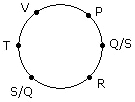
Cross-check:
S is just to the right of R: counting 1 seat in the right (counter-clockwise) direction from R lands on S — true.
T is just next to the right of V: counting 1 seat in the right (counter-clockwise) direction from V lands on T — true.
P is second to the right of R: counting 2 seats in the right (counter-clockwise) direction from R lands on P — true.
R is second to the left of T: counting 2 seats in the left (clockwise) direction from T lands on P, not R — false.
Answer: The statement that is not true is the one claiming R is second to the left of T: that would require T to occupy seat 2, which the earlier seating already fixes as P's seat — an impossible placement, whichever of the remaining seats T actually occupies.