The question contains some statements followed by some conclusions. Decide…
2023
The question contains some statements followed by some conclusions. Decide which of the given conclusions logically follow from the given statements, disregarding commonly known facts.
Statements:
Some dogs are bags.
No bag is lion.
All rooms are lions.
Conclusions:
I. Some rooms are bags.
II. Some dogs are lions.
III. Some rooms are dogs.
Answer: D. None follows — Concept: A conclusion 'follows' from given statements only if it is true in every possible Venn-diagram arrangement consistent with those statements, not…
- A.
Only conclusion I follows
- B.
Only conclusion II follows
- C.
Only conclusion III follows
- D.
None follows
Show answer & explanation
Correct answer: D
Concept: A conclusion 'follows' from given statements only if it is true in every possible Venn-diagram arrangement consistent with those statements, not merely in one plausible picture. Model an 'All X are Y' statement as X wholly inside Y, a 'No X is Y' statement as X and Y with no overlap, and a 'Some X are Y' statement as X and Y sharing at least one member (with no claim about the rest of either group). A conclusion is valid only when no consistent arrangement can violate it.
Given relations:
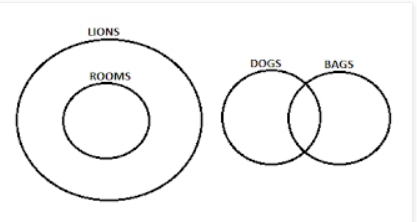
'All rooms are lions' -> Rooms lie wholly inside Lions.
'No bag is lion' -> Bags and Lions have no overlap at all.
'Some dogs are bags' -> Dogs and Bags share at least one member; the rest of Dogs is unconstrained.
Checking each conclusion:
Some rooms are bags (Conclusion I): Since Rooms lie wholly inside Lions and Bags lie wholly outside Lions, Rooms and Bags cannot share a member in any consistent arrangement -- Conclusion I fails.
Some dogs are lions (Conclusion II): The dog-bag overlap is guaranteed to fall outside Lions (bags are never lions), but the statements say nothing about the dogs that are not bags. An arrangement where every dog outside the bag-overlap also lies outside Lions is fully consistent with all three statements, so Conclusion II is not forced -- it fails.
Some rooms are dogs (Conclusion III): No statement links Rooms and Dogs, directly or through a shared, definitely-overlapping middle term. An arrangement with Rooms and Dogs entirely disjoint satisfies every statement, so Conclusion III is not forced -- it fails.
Cross-check: picture Lions as one region containing Rooms completely, Bags as a separate region outside Lions, and Dogs as a region overlapping only Bags (and nowhere touching Rooms or Lions). Every statement -- 'some dogs are bags', 'no bag is lion', 'all rooms are lions' -- holds true in this single diagram, yet none of Conclusions I, II, or III holds in it. Because a valid arrangement exists in which every conclusion fails, none of them follows.
Result: None of the three conclusions logically follows from the given statements.
The diagram below shows one such valid arrangement.