Statements: All ducks are pigeons. All pigeons are crows. Conclusions: I. Some…
2023
Statements:
All ducks are pigeons.
All pigeons are crows.
Conclusions:
I. Some crows are ducks.
II. Some crows are pigeons.
Answer: D. Both conclusion I and II follow. — Concept: Two immediate-inference rules apply to universal ('All X are Y') premises in syllogisms — (1) Chain rule: if All A are B and All B are C, then All A…
- A.
Only conclusion I follows.
- B.
Only conclusion II follows.
- C.
Either conclusion I or II follows.
- D.
Both conclusion I and II follow.
Attempted by 1 students.
Show answer & explanation
Correct answer: D
Concept: Two immediate-inference rules apply to universal ('All X are Y') premises in syllogisms — (1) Chain rule: if All A are B and All B are C, then All A are C. (2) Conversion by limitation: a universal affirmative 'All X are Y' always permits the particular 'Some Y are X' as a valid inference, since every X is also a Y.
Application:
From 'All ducks are pigeons' and 'All pigeons are crows', apply the chain rule: All ducks are crows.
Apply conversion to this chained relation — since all ducks are crows, some crows are ducks. This is Conclusion I.
Apply conversion directly to the second premise 'All pigeons are crows' — since all pigeons are crows, some crows are pigeons. This is Conclusion II.
Cross-check: A nested-circles diagram confirms this — draw Ducks fully inside Pigeons, and Pigeons fully inside Crows. Both the Duck circle and the Pigeon circle then lie entirely inside the Crow circle, so any duck or pigeon is also a crow, visually confirming both conclusions independently.
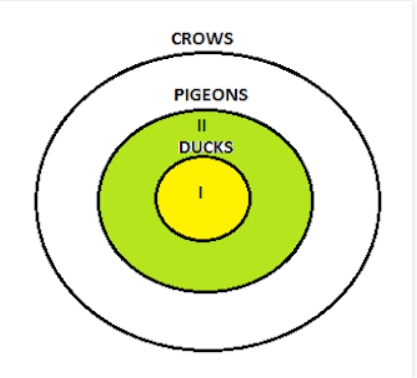
Conclusion I follows from chaining the two premises together and then converting the combined result, while Conclusion II follows directly by converting the second premise on its own -- so both conclusions are validly derived, each through its own independent route.