In the following question, a set of statements is given, followed by two…
2023
In the following question, a set of statements is given, followed by two conclusions numbered I and II. You must take the given statements to be true, even if they seem to differ from commonly known facts, and decide which of the conclusions logically follow(s) from the statements.
Statements:
I. No key is door.
II. All doors are pens.
III. Some pens are houses.
Conclusions:
I. No key is house.
II. Some pens are doors.
Answer: B. Only II follows — Concept: A universal affirmative premise of the form ‘All A are B’ always converts, by limitation, to ‘Some B are A’ — this conversion is logically…
- A.
Only I follows
- B.
Only II follows
- C.
Only III follows
- D.
Only I and II follow
Show answer & explanation
Correct answer: B
Concept:
A universal affirmative premise of the form ‘All A are B’ always converts, by limitation, to ‘Some B are A’ — this conversion is logically guaranteed. By contrast, when two terms are connected only through separate, unrelated premises (with no shared middle term directly linking them), no definite relationship between those two terms can be concluded; more than one Venn diagram can satisfy the same premises.
Setting up the relations:
“No key is door” — Key and Door are two separate, non-overlapping groups.
“All doors are pens” — Door is completely inside Pen.
“Some pens are houses” — Pen and House overlap partially (some pens are houses, some are not).
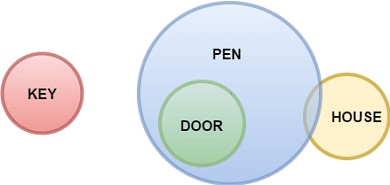
Checking “Some pens are doors”:
This is exactly the conversion of “All doors are pens” — since every door is a pen, some pens must be doors. The conversion of a universal affirmative always holds, so this conclusion is guaranteed true.
Checking “No key is house”:
To be certain that no key is a house, the statements would need to fix a definite relationship between Key and House. Key is only related to Door (fully separate), and House is only related to Pen (partial overlap) — nothing connects Key to House directly or through a shared term. So this relationship is left open by the premises.
Cross-check:
Draw an alternate diagram that still keeps all three statements true — Key and Door separate, Door fully inside Pen, Pen and House overlapping — but this time let the Key circle also touch the House circle. Every statement given still holds, yet “no key is house” is now false. Since a valid conclusion must hold in every diagram consistent with the premises, and this counter-diagram breaks it, this conclusion does not necessarily follow.
Answer:
Only “Some pens are doors” follows.