If A x B means A is to the south of B; A + B means A is to the north of B; A %…
20242023
If A x B means A is to the south of B; A + B means A is to the north of B; A % B means A is to the east of B; A - B means A is to the west of B; then in P % Q + R - S, S is in which direction with respect to Q?
Answer: B. South-East — Each symbol encodes a direction relation between two points: 'x' = south of, '+' = north of, '%' = east of, '-' = west of. A chain like P % Q + R - S links…
- A.
South-West
- B.
South-East
- C.
North-East
- D.
North-West
Attempted by 6 students.
Show answer & explanation
Correct answer: B
Each symbol encodes a direction relation between two points: 'x' = south of, '+' = north of, '%' = east of, '-' = west of. A chain like P % Q + R - S links several such point-pairs; to find how any two of those points relate, place them one at a time on a compass grid using each relation in turn, then read the net direction between the two points of interest directly off the grid.
P % Q means P is east of Q — this relation does not involve R or S, so it can be set aside when finding S's direction from Q.
Q + R means Q is north of R, which is equivalent to saying R is south of Q.
R - S means R is west of S, which is equivalent to saying S is east of R.
Place Q at the origin. From the previous step, R sits directly south of Q. From the step before that, S sits directly east of R.
Combining a southward shift (Q to R) with an eastward shift (R to S) gives S's net position relative to Q: south and east together, i.e. south-east.
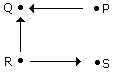
Checking with direction vectors confirms this: taking north=(0,1), south=(0,-1), east=(1,0), west=(-1,0), the position of S relative to Q is (R−Q) + (S−R) = south + east = a vector with a negative y-component and a positive x-component — exactly the south-east direction.
S is to the south-east of Q.