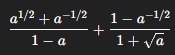
is equal to :
2023
is equal to :
Attempted by 6 students.
Show answer & explanation
Concept: For a > 0 with a ≠ 1 (so 1 − a ≠ 0), write a1/2 = √a and a−1/2 = 1/√a, and use the difference-of-squares identity 1 − a = (1 − √a)(1 + √a). Substituting x = √a turns every term into a rational function of x that can be combined over one common denominator.
Application:
Let x = √a, so a1/2 = x, a−1/2 = 1/x, and 1 − a = (1 − x)(1 + x).
First term: (x + 1/x)/[(1−x)(1+x)] = [(x2+1)/x] / [(1−x)(1+x)] = (x2+1) / [x(1−x)(1+x)].
Second term: (1 − 1/x)/(1+x) = [(x−1)/x] / (1+x) = (x−1) / [x(1+x)].
Bring both terms to the common denominator x(1−x)(1+x): the second term becomes (x−1)(1−x) / [x(1−x)(1+x)].
Add the numerators: (x2+1) + (x−1)(1−x) = (x2+1) − (1−x)2 = (x2+1) − (1 − 2x + x2) = 2x.
So the sum = 2x / [x(1−x)(1+x)] = 2 / [(1−x)(1+x)] = 2 / (1−x2) = 2 / (1−a).
Cross-check: Test a = 4 (so √a = 2): first term = (2 + 1/2)/(1−4) = −5/6; second term = (1 − 1/2)/(1+2) = 1/6; sum = −5/6 + 1/6 = −2/3. And 2/(1−a) = 2/(1−4) = −2/3 — the two match, confirming the simplification.
So the given expression simplifies to 2/(1 − a).