Evaluate the continued fraction: In symbols: x = 2 + 1/(3 + 1/(4 + 1/2)).
2025
Evaluate the continued fraction:
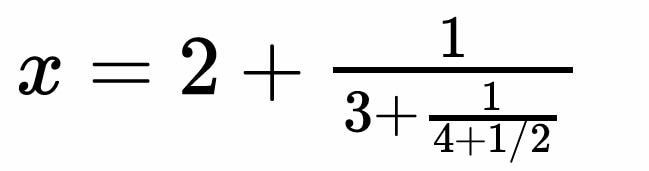
In symbols: x = 2 + 1/(3 + 1/(4 + 1/2)).
Answer: A. 67/29 — Concept: A continued fraction is a nested expression such as a + 1/(b + 1/(c + 1/d)). Each 1/… stands over the whole level beneath it, so the value has to be…
- A.
67/29
- B.
41/17
- C.
45/19
- D.
47/20
Attempted by 1 students.
Show answer & explanation
Correct answer: A
Concept: A continued fraction is a nested expression such as a + 1/(b + 1/(c + 1/d)). Each 1/… stands over the whole level beneath it, so the value has to be built from the innermost denominator outward. Two identities do all the work: an integer plus a fraction combines as a + p/q = (aq + p)/q, and the reciprocal of a fraction is 1/(p/q) = q/p.
Application: unfold the given expression one level at a time, starting at the bottom.
Innermost level: 4 + 1/2 = (4 × 2 + 1)/2 = 9/2.
Its reciprocal: 1/(9/2) = 2/9.
Next level up: 3 + 2/9 = (3 × 9 + 2)/9 = 29/9.
Its reciprocal: 1/(29/9) = 9/29.
Outermost level: x = 2 + 9/29 = (2 × 29 + 9)/29 = 67/29.
Cross-check: repeating the same climb in decimals gives 4 + 1/2 = 4.5, then 3 + 1/4.5 = 3.2222…, then 2 + 1/3.2222… = 2.3103…, and 67/29 = 2.3103…, so both routes agree. Also, 29 is prime and does not divide 67, so 67/29 is already in lowest terms.
Common pitfall: reading the expression top-down and adding the pieces separately, as in 2 + 1/3 + 1/4 + 1/2, changes its meaning — every 1/… applies to the whole level written below it, not to the single number standing next to it.