Match the ways of reading with what readers do:
2023
Match the ways of reading with what readers do:
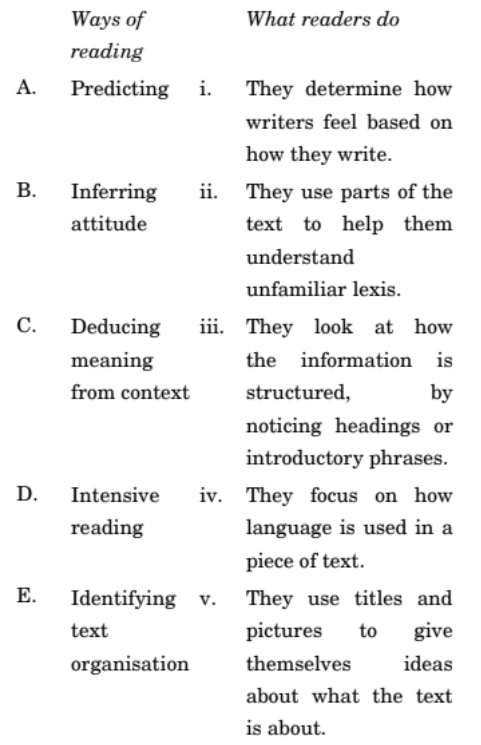
Answer: B. A-v, B-i, C-ii, D-iv, E-iii — Concept: Reading is not a single uniform skill — proficient readers switch strategies to match their purpose. Predicting uses paratextual cues such as titles…
- A.
A-iv, B-iii, C-ii, D-i, E-v
- B.
A-v, B-i, C-ii, D-iv, E-iii
- C.
A-i, B-iv, C-v, D-ii, E-iii
- D.
A-ii, B-i, C-iii, D-iv, E-v
Show answer & explanation
Correct answer: B
Concept: Reading is not a single uniform skill — proficient readers switch strategies to match their purpose. Predicting uses paratextual cues such as titles and pictures to form expectations before reading; inferring a writer's attitude means reading tone and word choice to work out how the writer feels; deducing meaning from context means using the surrounding text to work out an unfamiliar word's meaning; intensive reading is a close, detailed analysis of exactly how language is used in a passage; and identifying a text's organisation means noticing structural signals — headings, introductory phrases, paragraph breaks — that show how the information is arranged.
Application: Matching each numbered description in "What readers do" to the reading skill it defines gives the pairing below.
Ways of reading | What readers do |
|---|---|
A. Predicting | v. They use titles and pictures to give themselves ideas about what the text is about. |
B. Inferring attitude | i. They determine how writers feel based on how they write. |
C. Deducing meaning from context | ii. They use parts of the text to help them understand unfamiliar lexis. |
D. Intensive reading | iv. They focus on how language is used in a piece of text. |
E. Identifying text organisation | iii. They look at how the information is structured, by noticing headings or introductory phrases. |
Cross-check: Each description contains a keyword that anchors it to exactly one reading skill and to no other — "titles and pictures" signals anticipating content before reading, i.e. predicting; "how writers feel" signals reading between the lines for tone, i.e. inferring attitude; "unfamiliar lexis" signals working out a word's meaning from surrounding text, i.e. deducing meaning from context; "how language is used" signals close analysis of form, i.e. intensive reading; and "headings or introductory phrases" signals noticing structural layout, i.e. identifying organisation. Every one of the five ways of reading is used exactly once and every one of the five descriptions is used exactly once, so this pairing accounts for the whole table without leaving any term or description unmatched. Result: A-v, B-i, C-ii, D-iv, E-iii is the arrangement in which every reading skill is paired with the description of what it makes a reader actually do.