Match List I with List II : List I provides the basic management functions to…
2020
Match List I with List II : List I provides the basic management functions to be performed by a teacher while the List II gives their description.
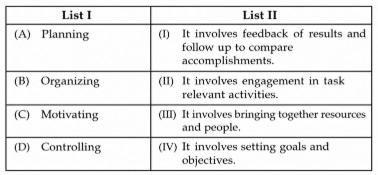
Choose the correct answer from the options given below :
- A.
(A)-(IV), (B)-(III), (C)-(II), (D)-(I)
- B.
(A)-(I), (B)-(II), (C)-(III), (D)-(IV)
- C.
(A)-(II), (B)-(I), (C)-(IV), (D)-(III)
- D.
(A)-(III), (B)-(IV), (C)-(I), (D)-(II)
Show answer & explanation
Correct answer: A
Management theory analyses managerial work into four classical functions, often summarised as Planning, Organizing, Motivating (Directing/Leading), and Controlling. Each function marks a distinct stage in the management cycle: Planning decides objectives and the course of action in advance; Organizing assembles the resources and people required to carry out that plan; Motivating engages people in the tasks relevant to the plan; and Controlling closes the loop by measuring results and following up against the intended accomplishments.
Planning is the function of deciding goals and objectives in advance, so it matches the description that it involves setting goals and objectives — description (IV).
Organizing is the function of assembling resources and people to execute the plan, so it matches the description that it involves bringing together resources and people — description (III).
Motivating is the function of engaging people in the tasks relevant to the plan, so it matches the description that it involves engagement in task-relevant activities — description (II).
Controlling is the function of reviewing results and following up by comparing them with the intended accomplishments, so it matches the description that it involves feedback of results and follow-up to compare accomplishments — description (I).
These four descriptions are mutually exclusive — goal-setting, resource assembly, task engagement, and results feedback each describe a different stage of the management cycle — so each letter maps to exactly one Roman numeral, and no other pairing of all four functions is consistent with the descriptions given.
Hence the complete match is (A)-(IV), (B)-(III), (C)-(II), (D)-(I).