The sequence of folding a piece of paper and the manner in which the folded…
2023
The sequence of folding a piece of paper and the manner in which the folded paper has been cut is shown below. Choose the figure that would most closely resemble the unfolded form of the paper.
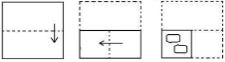
Attempted by 9 students.
Show answer & explanation
Concept — A cut made through a folded sheet goes through every layer stacked at that spot, so a single cut on a sheet folded n times opens out into 2n identical holes. Unfolding runs the folds backwards one at a time, and each unfold reflects everything already cut across that fold's crease. A reflection reverses direction across the crease, so the opened pattern is mirror-symmetric about every crease line.
Application
First fold: the sheet is folded along its horizontal centre line, the top edge coming down onto the bottom edge. The sheet is now the bottom half, two layers thick.
Second fold: that half is folded along its vertical centre line, the right edge coming across onto the left. The sheet is now the bottom-left quarter, four layers thick.
Two cuts are made in this quarter — one in its upper-left region and a second below it and to its right, so within the pair the upper cut lies to the left of the lower cut. With four layers stacked, 2 cuts x 4 layers = 8 holes on the opened sheet, two in every quarter.
Undo the vertical fold. Reflecting the bottom-left pair across the vertical crease swaps left and right, so in the bottom-right quarter the upper cut lies to the right of the lower cut.
Undo the horizontal fold. Reflecting the bottom half across the horizontal crease swaps top and bottom but leaves left and right untouched, so each pair turns over: in the top-left quarter the upper cut lies to the right of the lower cut, and in the top-right quarter it lies to the left of it.
Cross-check — both creases are lines of symmetry of the opened sheet, so the answer has to pass all three tests below.
Across the vertical crease the two top pairs must step in opposite left-right directions, and so must the two bottom pairs. A pattern whose two top pairs step the same way was slid sideways rather than reflected.
Across the horizontal crease the top-left and bottom-left pairs must step in opposite directions, and so must the top-right and bottom-right pairs. A pattern whose left half steps the same way above and below was copied upward rather than reflected.
The bottom-left quarter must reproduce the cut quarter exactly — upper cut to the left of the lower cut.
Result — the opened sheet carries eight holes, and the pairs read as follows.
Quarter of the sheet | Upper cut of the pair lies |
|---|---|
Top-left | to the right of the lower cut |
Top-right | to the left of the lower cut |
Bottom-left | to the left of the lower cut |
Bottom-right | to the right of the lower cut |
The unfolded sheet is therefore the figure whose pairs read right, left, left and right for the top-left, top-right, bottom-left and bottom-right quarters respectively.