In the given graph identify the cut vertices:
2018
In the given graph identify the cut vertices:
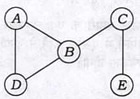
Answer: D. C and B — Concept — In a connected graph, a cut vertex (articulation point) is a vertex whose deletion, together with its incident edges, leaves a graph with more…
- A.
B and E
- B.
C and D
- C.
A and E
- D.
C and B
Attempted by 20 students.
Show answer & explanation
Correct answer: D
Concept — In a connected graph, a cut vertex (articulation point) is a vertex whose deletion, together with its incident edges, leaves a graph with more connected components than before. Equivalently, a vertex v is a cut vertex when some pair of other vertices is joined only by paths that run through v. A vertex of degree 1 can never be a cut vertex, because deleting it destroys no route between any other pair of vertices.
Application — Read the edge set off the figure: A–B, A–D, B–D, B–C and C–E. Together these five edges hold all five vertices in a single component. Now delete each vertex in turn, keep only the edges that survive, and count the components.
Delete A: the surviving edges are B–D, B–C and C–E, which still hold B, C, D and E in one component. The component count stays at 1.
Delete B: the surviving edges are A–D and C–E only, leaving the two separate components {A, D} and {C, E}. The count rises from 1 to 2.
Delete C: the surviving edges are A–B, A–D and B–D, which hold A, B and D together, while E is left with no edge at all — the components are {A, B, D} and {E}. The count rises from 1 to 2.
Delete D: the surviving edges are A–B, B–C and C–E, which still hold A, B, C and E in one component. The count stays at 1.
Delete E: the surviving edges are A–B, A–D, B–D and B–C, which still hold A, B, C and D in one component. The count stays at 1.
Cross-check — The same two vertices fall out of a structural read. The triangle A–B–D is attached to the path B–C–E only at B, and E hangs off the rest of the graph only at C, so every route across those joins is forced through B and through C respectively. A and D each keep an alternative route through the third side of the triangle, and E has degree 1, so none of those three can be essential. The step-by-step count and the structural read agree.
Result — The cut vertices of this graph are B and C, so the pairing C and B is the selection to make.
Contrasting the other pairings —
The pairing B and E breaks down on E: E has a single edge, to C, so deleting it still leaves A–B, A–D, B–D and B–C holding the other four vertices together.
The pairing C and D breaks down on D: deleting D still leaves A–B, B–C and C–E holding A, B, C and E together.
The pairing A and E breaks down on A: deleting A still leaves B–D, B–C and C–E holding B, C, D and E together.