Analyze the architecture of a standard Cryptosystem by detailing its…
Analyze the architecture of a standard Cryptosystem by detailing its functional components. Furthermore, contrast the operational mechanisms of Symmetric and Asymmetric Key Encryption.
Attempted by 17 students.
Show answer & explanation
Conceptual Overview
A Cryptosystem is a comprehensive framework of cryptographic algorithms and protocols designed to ensure data confidentiality. It acts as a shield, transforming sensitive information into a format that remains unintelligible to unauthorized entities, such as interceptors or eavesdroppers.
Core Functional Components
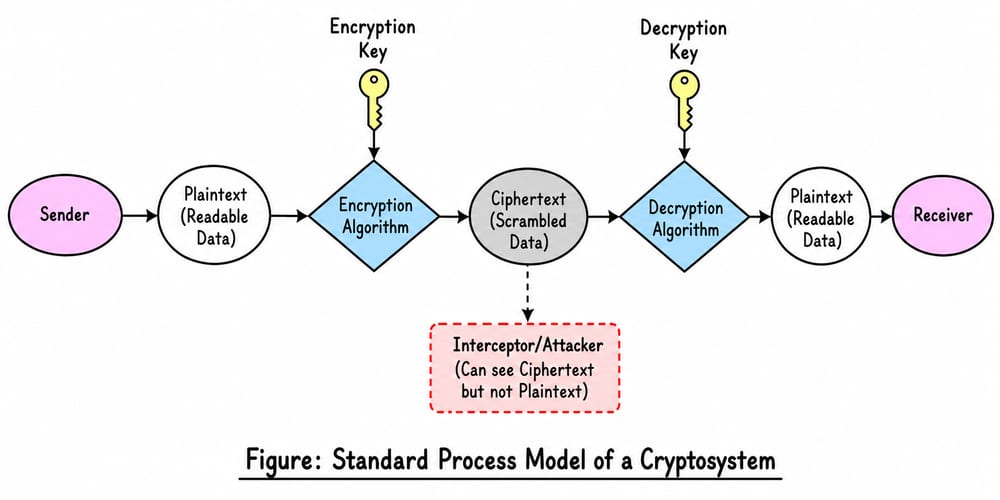
A robust cryptosystem is built upon five pillars:
Plaintext: The raw, unencrypted data that requires protection during transmission.
Encryption Algorithm: The mathematical logic applied to the plaintext to obscure its meaning.
Ciphertext: The resultant encrypted data that is transmitted across potentially insecure channels.
Decryption Algorithm: The inverse logic used by the receiver to restore the original message.
Cryptographic Keys: Variables (Encryption and Decryption keys) that determine the output of the algorithms. The security of the system depends on the secrecy of these keys rather than the algorithm itself.
Operational Differences : Symmetric vs. Asymmetric
The table below highlights the fundamental differences between the two primary encryption methodologies:
Feature | Symmetric Key Encryption | Asymmetric Key Encryption |
Number of Keys | Uses a single, shared secret key. | Uses a pair of keys (Public and Private). |
Key Usage | Same key is used for both encryption and decryption. | Public key encrypts; Private key decrypts. |
Speed | Highly efficient and fast; ideal for large data. | Computationally slow due to complex math. |
Key Distribution | Difficult; requires a secure way to share the key. | Easy; Public keys can be shared openly. |
Resource Usage | Low overhead and low power consumption. | High overhead and requires more processing power. |
Common Algorithms | DES, AES, Blowfish. | RSA, Diffie-Hellman, ECC. |