Which topology of networks is represented in the following diagram?
2022
Which topology of networks is represented in the following diagram?
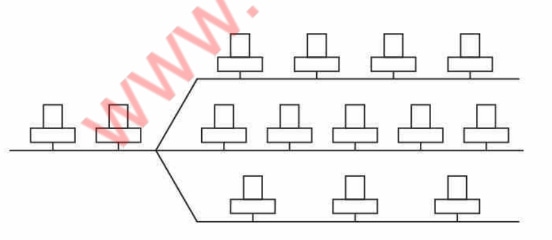
Answer: D. TREE — ConceptA network topology is the geometric pattern in which nodes and links are arranged. The defining tests are: a bus is one single shared backbone line; a…
- A.
BUS
- B.
RING
- C.
STAR
- D.
TREE
Attempted by 4728 students.
Show answer & explanation
Correct answer: D
Concept
A network topology is the geometric pattern in which nodes and links are arranged. The defining tests are: a bus is one single shared backbone line; a ring is one closed loop; a star is many dedicated links to one central hub; and a tree is a hierarchy in which a root link branches into several lower-level segments — a parent-to-child arrangement, often built by joining bus or star segments through a backbone.
Applying it to this diagram
Start at the short segment on the left; it carries a couple of nodes and acts as the root.
At a junction this root fans out into three separate horizontal segments stacked at one level below it.
Each of those segments carries its own row of nodes, so the layout has clear parent-to-child levels rather than one flat line.
Cross-check against the other layouts
Not a bus: there is no single continuous line holding every node; the line branches into several segments.
Not a ring: the branches are open-ended and never close back into a loop.
Not a star: nodes share horizontal segments instead of each having its own dedicated link to one central hub.
Result: the branching, multi-level hierarchy of interconnected segments is the tree topology.
Note on a common doubt: the two devices on the left segment are ordinary nodes sitting on the root segment, not two separate roots. A tree topology routinely has several nodes on its backbone; what makes it a tree is the branching into lower-level segments, which the diagram clearly shows.
A video solution is available for this question — log in and enroll to watch it.