Explain the end-to-end principle in network design. Evaluate its impact on the…
2025
Explain the end-to-end principle in network design. Evaluate its impact on the evolution of the Internet architecture and its interaction with middleboxes such as NATs and firewalls. Discuss how the proliferation of these intermediary devices challenges the principle, and critically assess whether the modern Internet still adheres to the end-to-end philosophy. Reflect on the future implications of this shift for protocol design and innovation.
Attempted by 43 students.
Show answer & explanation
End-to-End Principle in Network Design
1. Definition
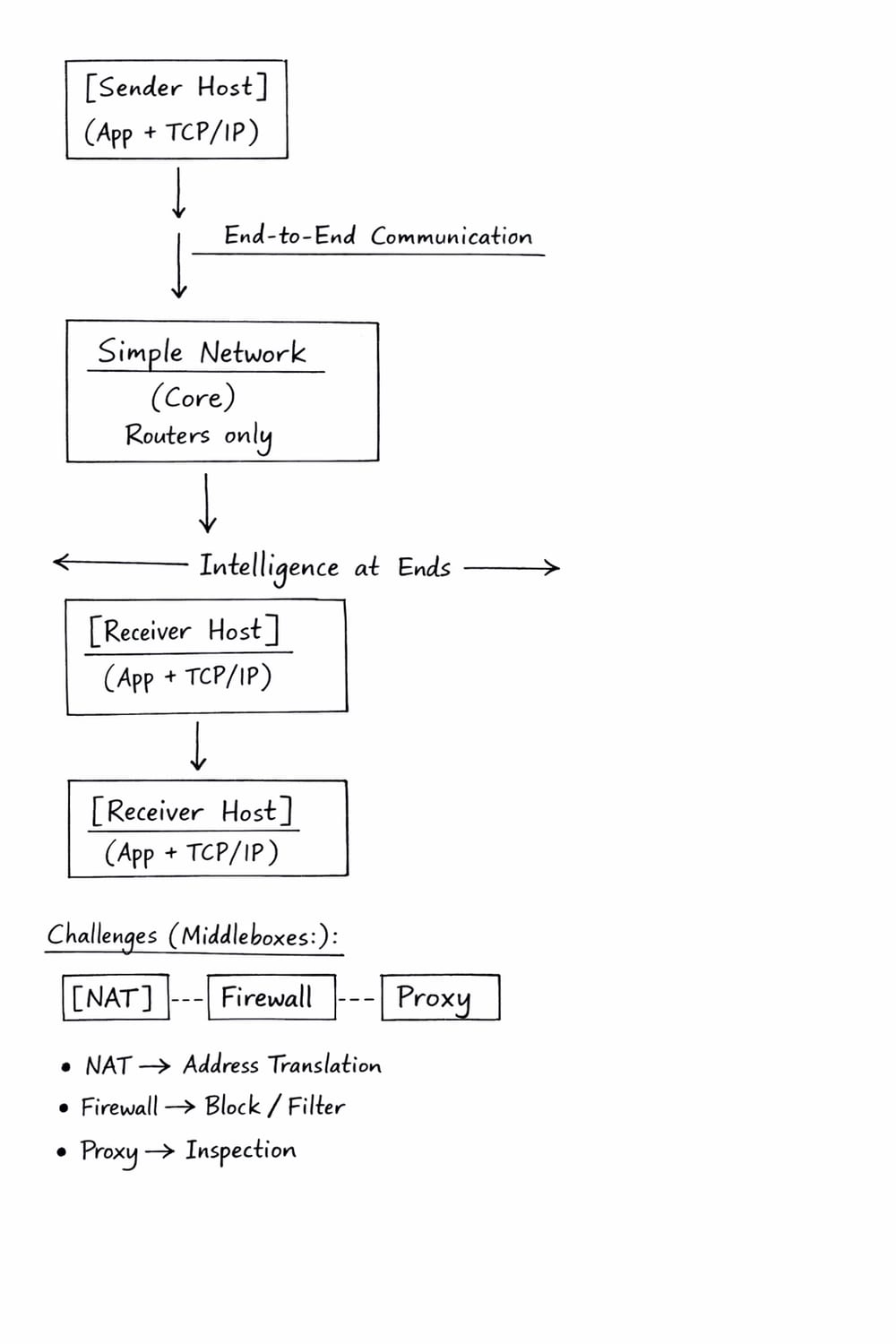
End-to-End Principle states that network core should be simple, and intelligence should reside at endpoints (hosts)
Proposed by Saltzer, Reed, and Clark
Functions like reliability, security, and error handling are implemented at end systems
2. Impact on Internet Evolution
Led to TCP/IP architecture (dumb network, smart edges)
Enabled:
Scalability (network easily expand hua)
Flexibility (new applications without network changes)
Innovation (Web, Email, P2P developed independently)
3. Interaction with Middleboxes
Middleboxes: NAT, Firewalls, Proxies
Perform:
Address translation (NAT)
Traffic filtering (Firewall)
Packet inspection
4. Challenges to End-to-End Principle
Breaks transparency of communication
NAT destroys global addressability
Firewalls restrict direct host-to-host communication
Protocols need workarounds (e.g., tunneling)
5. Modern Internet Status
Internet partially follows end-to-end principle
Due to:
Security requirements
IPv4 address shortage
Network management needs
6. Future Implications
Shift towards hybrid architecture
Protocols must consider middlebox compatibility
Possible move with IPv6 & zero-trust security models
Innovation may slow due to network constraints
Conclusion
End-to-End Principle remains foundational, but modern Internet is no longer purely end-to-end, requiring a balanced design approach.