Given an instance of the relation R(ABCD). Which of the following functional…
2018
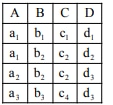
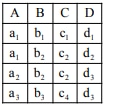
Given an instance of the relation R(ABCD). Which of the following functional dependencies hold?
Answer: C. {A B} → C and B → C — Concept. A functional dependency X → Y holds on a relation instance when every pair of rows that agree on all attributes of X also agree on Y. Equivalently, X…
- A.
{A B} → D and D → A
- B.
{A B} → C and B → D
- C.
{A B} → C and B → C
- D.
{A B} → D and A → D
Attempted by 837 students.
Show answer & explanation
Correct answer: C
Concept. A functional dependency X → Y holds on a relation instance when every pair of rows that agree on all attributes of X also agree on Y. Equivalently, X → Y fails the moment two rows share the same X-value but carry different Y-values — a single counter-example is enough to break it.
Application. The given instance of R(A, B, C, D) is:
A | B | C | D |
|---|---|---|---|
a1 | b1 | c1 | d1 |
a1 | b2 | c2 | d2 |
a2 | b2 | c2 | d3 |
a3 | b3 | c4 | d3 |
Test each dependency that appears among the choices by scanning for two rows with equal left-hand side but unequal right-hand side:
{A, B} → C: Holds — every distinct (A, B) pair carries one C value — (a1, b1)→c1, (a1, b2)→c2, (a2, b2)→c2, (a3, b3)→c4.
B → C: Holds — each B value maps to exactly one C — b1→c1, b2→c2 (both rows with b2 give c2), b3→c4.
B → D: Fails — b2 appears with two different D values, d2 and d3, so B cannot determine D.
A → D: Fails — a1 appears with d1 and d2, so A cannot determine D.
D → A: Fails — d3 appears with a2 and a3, so D cannot determine A.
Result. A choice is valid only when BOTH of its dependencies hold. Only the pair {A, B} → C together with B → C satisfies that requirement; every other pairing includes one of the failing dependencies above (B → D, A → D, or D → A) and is therefore rejected.