Distinguish between cycles and circuits in both directed and undirected…
2025
Distinguish between cycles and circuits in both directed and undirected graphs. Explain how the detection of these structures varies depending on graph type and representation. Also explain how cycle detection plays a critical role in applications such as deadlock detection, scheduling, and electronic circuit design.
Attempted by 17 students.
Show answer & explanation
Introduction
In graph theory, cycles and circuits represent closed paths that start and end at the same vertex.
They differ mainly in the repetition of vertices and edges.
These concepts are important in many computer science applications such as deadlock detection, scheduling, and electronic circuit analysis.
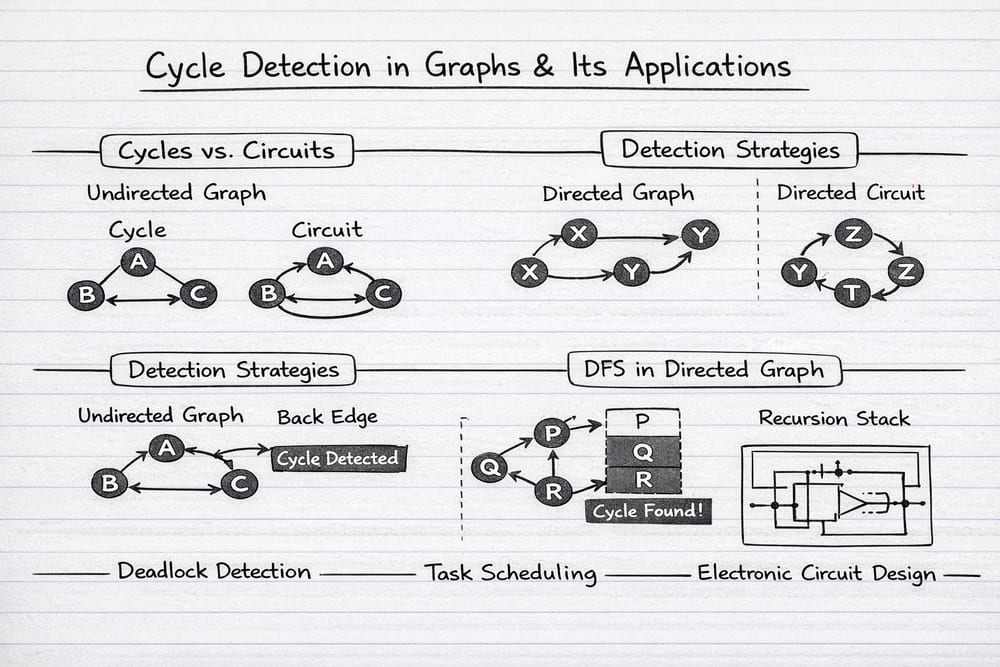
1. Cycles vs. Circuits
Undirected Graph
Cycle:
A simple closed path where no vertex or edge is repeated except the starting and ending vertex.
Example: v1−v2−v3−v1.
Circuit:
A closed trail where the path starts and ends at the same vertex.
Edges cannot repeat, but vertices may repeat.
Directed Graph (Digraph)
Directed Cycle:
A sequence of vertices v1 → v2 → ...→ vn → v1.
All edges must follow the direction of arrows.
Directed Circuit:
A closed directed path that respects the direction of edges and returns to the starting vertex.
2. Detection Strategies and Graph Representation
Cycle Detection in Undirected Graphs
Performed using Depth First Search (DFS).
If during traversal a visited vertex is found that is not the parent of the current vertex, a cycle exists.
Cycle Detection in Directed Graphs
DFS with Recursion Stack:
If a vertex appears again in the recursion stack, a back edge is detected → cycle exists.
Topological Sorting (Kahn’s Algorithm):
If topological ordering cannot be completed, the graph contains a cycle.
Impact of Graph Representation
Adjacency List
Efficient for sparse graphs.
Time complexity: O(V+E).
Adjacency Matrix
Suitable for dense graphs.
Detection complexity: O(V2).
3. Critical Applications
Deadlock Detection (Operating Systems)
Processes and resources are modeled using a Resource Allocation Graph (RAG).
A cycle in the graph indicates a deadlock where processes wait indefinitely for resources.
Task Scheduling
Scheduling problems are modeled as Directed Acyclic Graphs (DAGs).
A cycle represents circular dependency, making scheduling impossible.
Electronic Circuit Design
Used to detect feedback loops in digital and sequential circuits.
Helps verify circuit correctness and stability.
Conclusion
Cycle detection is a fundamental analysis technique in graph-based systems.
It helps prevent deadlocks, circular dependencies in scheduling, and incorrect circuit behavior, ensuring system reliability and correctness.