Consider the following three binary trees, each with 7 nodes. Then A is ____…
2018
Consider the following three binary trees, each with 7 nodes. Then A is ____ binary tree, B is ____ binary tree and C is ____ binary tree.
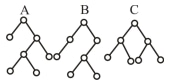
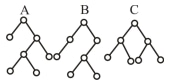
Note: if a tree fits more than one of the given terms, use the term that is not already assigned to another tree in this set.
Answer: D. strictly, not strictly, complete — Concept: A binary tree is strictly (also called full or proper) binary when every internal node has exactly 0 or 2 children — never exactly 1. It is complete…
- A.
strictly, strictly, complete
- B.
complete, not strictly, strictly
- C.
strictly, not strictly, strictly
- D.
strictly, not strictly, complete
Attempted by 796 students.
Show answer & explanation
Correct answer: D
Concept: A binary tree is strictly (also called full or proper) binary when every internal node has exactly 0 or 2 children — never exactly 1. It is complete when every level is filled completely except possibly the last level, and that last level's nodes are packed as far left as possible. A tree that is perfect (every internal node has 2 children and every leaf sits at the same depth) always satisfies both definitions at once, since it has no partially filled level and no node with a single child.
Checking each of the three 7-node trees against these rules:
Leftmost tree (A): the root and its two internal descendants each have exactly two children, so every internal node follows the 0-or-2 rule — the tree is strictly (full) binary. Its leaves, however, sit at three different depths (one leaf hangs directly under the root, one hangs two levels down, two hang three levels down), so the last level is not fully and evenly filled — the tree is not complete.
Middle tree (B): one internal node — the root's left child — has only a single child, breaking the 0-or-2 rule, so the tree is not strictly binary. (Its leaves are also unevenly placed, so it is not complete either.)
Rightmost tree (C): the root and both its children each have exactly two children, and all four leaves sit at the same last level, packed left to right — so the tree is both strictly (full) binary AND complete, because it is a perfect binary tree.
Tree | 0-or-2 children rule (strict test) | Last level fully & evenly filled (complete test) | Label used in this question |
|---|---|---|---|
A | Satisfied | Not satisfied | strictly |
B | Not satisfied | Not satisfied | not strictly |
C | Satisfied | Satisfied | complete |
Why C is labelled 'complete' and not 'strictly': The rightmost tree genuinely satisfies both definitions — it is not wrong to call it strictly binary too. But this question's three blanks are meant to test three different properties, and the leftmost tree already illustrates 'strictly binary but not complete'. Since the rightmost tree's distinguishing feature here is that its last level is filled completely and evenly (something the leftmost tree does NOT have), 'complete' is the label the official answer key uses for it. This matches the rule stated in the question: a term already used for one tree in the set should not be reused for another.
So: A is strictly binary, B is not strictly binary, and C is complete — matching the option 'strictly, not strictly, complete'.