The diagram below represents a solution to the ____
2013
The diagram below represents a solution to the ____
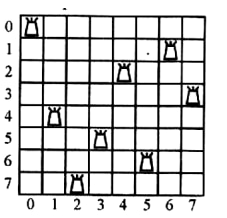
- A.
Knight's Tour
- B.
Eight Queens Problem
- C.
King's Problem
- D.
Rook's Problem
Attempted by 117 students.
Show answer & explanation
Correct answer: B
Concept: The N-Queens problem asks for an arrangement of N queens on an N×N chessboard so that no two queens attack each other. Since a queen attacks along its entire row, column, and both diagonals, a valid placement must give every queen a distinct row, a distinct column, and a distinct diagonal from every other queen.
Application: For the given diagram (N = 8), the queens sit at row-column pairs (0,0), (1,6), (2,4), (3,7), (4,1), (5,3), (6,5) and (7,2). Every row number 0–7 and every column number 0–7 appears exactly once, so no two queens share a row or a column. Checking every pair of queens also confirms no two lie on a common diagonal (the absolute (magnitude) difference between their row numbers never equals the absolute difference between their column numbers). All three attack directions are therefore avoided.
Cross-check: This rules out the other named puzzles, each of which uses a different rule:
Knight's Tour: a single knight must visit all 64 squares once via L-shaped moves - one moving piece, not eight simultaneously placed pieces.
King's Problem: only forbids two kings from sitting on directly adjacent squares (including diagonal neighbours) - a much looser rule than requiring a distinct row, column, and diagonal for every piece.
Rook's Problem: only forbids sharing a row or a column - it places no restriction on diagonals at all.
Since the arrangement satisfies the full row, column, and diagonal separation that only the Eight Queens condition requires, the diagram is a valid solution to the Eight Queens Problem.