Two different positions of the same dice are shown, the six faces of which are…
2022
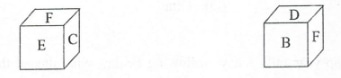
Two different positions of the same dice are shown, the six faces of which are marked from A to F. Select the letter that will be on the face opposite to the face showing the letter ‘C’.
Answer: B. B — When two positions of the same die are shown, the three faces visible in any single view (its Top, its Front-facing face, and its Right-facing face) are…
- A.
F
- B.
B
- C.
A
- D.
D
Attempted by 51 students.
Show answer & explanation
Correct answer: B
When two positions of the same die are shown, the three faces visible in any single view (its Top, its Front-facing face, and its Right-facing face) are always mutually adjacent, so none of them can be opposite one another. A letter common to both views lets us align the two views along that shared face; the remaining difference between the views then becomes a pure spin about that shared face's axis, and tracking that spin (Front → Right → Back → Left → Front) tells us exactly which hidden face pairs with which visible one.
In the first position: Top = F, Front = E, Right = C, so F, E and C are mutually adjacent — none of them is opposite another among the three.
In the second position: Top = D, Front = B, Right = F, so D, B and F are mutually adjacent likewise.
F is the letter common to both positions. Tipping the second die so its Right face (F) becomes the new Top (matching the first die's Top) moves its old Top (D) to the new Left, while its Front (B) is unaffected by this tip; the second position now reads Top = F, Left = D, Front = B.
Both dice now show F on Top, so the only remaining difference between them is a spin about the vertical (Top) axis. Comparing the first die's Front → Right pair (E → C) with the re-oriented second die's Front → Left pair (B → D) shows the spin must run clockwise (viewed from above) through Front → Right → Back → Left → Front — a counter-clockwise spin would force the Front face to read C instead of B, which contradicts the given data.
Applying that clockwise spin to the first die's own hidden faces: its Front (E) moves into the Right slot, its Right (C) moves into the Back slot, its hidden Left moves into the Front slot, and its hidden Back moves into the Left slot. Matching this against the re-oriented second position (Front = B, Left = D) gives: the first die's hidden Left = B and its hidden Back = D.
Left is always opposite Right on a die, so the first die's hidden Left (B) is opposite its Right face (C).
Checking the remaining pairs confirms consistency: Front (E) pairs with the newly-found Back (D), and Top (F) pairs with the one letter that never appears in either view, A — so the three opposite pairs are F–A, E–D and C–B, using all six letters A–F exactly once.
So the face opposite C is B.