Consider the circuit shown below; its output, marked f in the figure, is the…
2012
Consider the circuit shown below; its output, marked f in the figure, is the signal Y. In a certain steady state, Y is at logical ‘1’. What are possible values of A, B, C?
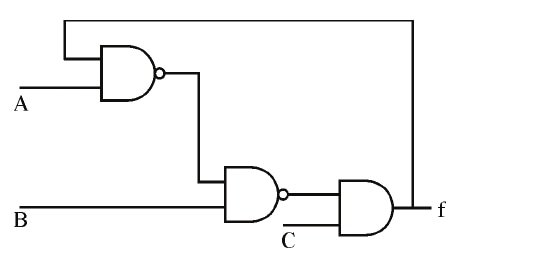
Answer: A. A = 0, B = 0, C = 1 — ConceptA NAND gate outputs 0 only when every one of its inputs is 1; a single 0 on any input pins its output to 1. An AND gate is the mirror image — it…
- A.
A = 0, B = 0, C = 1
- B.
A = 0, B = C = 1
- C.
A = 1, B = C = 0
- D.
A = B = 1, C = 0
Attempted by 19 students.
Show answer & explanation
Correct answer: A
Concept
A NAND gate outputs 0 only when every one of its inputs is 1; a single 0 on any input pins its output to 1. An AND gate is the mirror image — it outputs 1 only when every input is 1, and a single 0 on any input pins its output to 0.
When a circuit feeds its own output back into an earlier gate, a steady state is a self-consistent assignment of levels: the output level you assume must be exactly the level the circuit reproduces once that assumption is propagated all the way round the loop. The method is therefore fixed — assume the stated output level, push it back through the feedback path, and keep only those input combinations that regenerate the same level.
Applying it to this circuit
Name the three gate outputs. P is the output of the first NAND gate, which is driven by A and by the feedback line coming from the circuit output. Q is the output of the second NAND gate, which is driven by P and B. The circuit output Y = f is the AND of Q and C.
Assume the steady state stated in the question: Y = f = 1.
The output AND gate delivers 1 only when both of its inputs are 1, so C = 1 and Q = 1 are both forced.
Push f = 1 back into the first NAND gate: P = NAND(A, 1) = NOT A, so that gate simply inverts A.
Q = 1 requires NAND(P, B) = 1, that is P · B = 0; substituting P = NOT A gives (NOT A) · B = 0.
(NOT A) · B = 0 is satisfied when A = 1 or when B = 0. Every steady state with Y = 1 therefore needs C = 1 together with A = 1 or B = 0.
Among the four assignments offered, A = 0, B = 0, C = 1 is the one that meets both requirements: it has C = 1 and it has B = 0.
Cross-check by propagation
Assume Y = f = 1 and propagate each offered assignment right round the loop. The table lists P = NAND(A, f), then Q = NAND(P, B), and finally the regenerated output f = Q · C.
A | B | C | P = NAND(A, f) | Q = NAND(P, B) | f = Q · C |
|---|---|---|---|---|---|
0 | 0 | 1 | 1 | 1 | 1 |
0 | 1 | 1 | 1 | 0 | 0 |
1 | 0 | 0 | 0 | 1 | 0 |
1 | 1 | 0 | 0 | 1 | 0 |
Only A = 0, B = 0, C = 1 regenerates the assumed f = 1, so it alone is a self-consistent steady state; the other three assignments contradict the assumption and cannot hold with Y at logical 1.
Hence the possible input values are A = 0, B = 0, C = 1.