Problem Figures :
2026
Problem Figures :
Attempted by 24 students.
Show answer & explanation
In a figure-analogy pattern-completion item, two problem figures establish a transformation rule applied to a small set of basic shapes; the option that correctly extends the series is the one obtained by applying that EXACT operation, not a different-looking operation that happens to touch the same starting shapes.
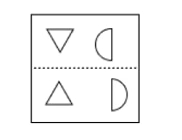
Here the operation shown is a 180-degree turn (point rotation) about the centre of the panel -- every basic shape swings to its rotationally opposite orientation as a single move, distinct from a mirror-flip across an edge or from drawing a shape's start and end stages together.
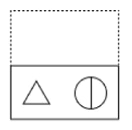
Applying the operation: the inverted triangle in the upper panel rotates 180 degrees about the panel's centre to become an upright triangle in the lower panel, and the left-facing semicircle rotates the same way to become a right-facing semicircle. Extending this rotation to the answer panel's triangle and semicircle-pair gives a single upright triangle together with a circle divided by one straight line -- the semicircle's rotated copy meets its own start position edge to edge, completing a full circle split along that single seam.
Reflecting the triangle across its own apex instead of rotating it about the panel's centre leaves the mirrored triangle touching the original at just that one point, producing a bow-shaped outline rather than the rotated triangle's own new position.
Drawing the triangle's start and end orientations directly on top of each other, instead of showing only the rotated result, produces a six-pointed star; treating the semicircle's start and end positions as two separate call-outs rather than one rotated piece meeting its own start edge produces a visible gap instead of a single seam.
Reflecting the triangle across its own base instead of rotating it about the panel's centre leaves the mirrored triangle joined edge-to-edge with the original, producing a kite-shaped outline rather than the rotated triangle's own new position.
Only rotating each shape 180 degrees about the panel's centre -- not reflecting it across an edge, and not drawing both its stages together -- gives the upright triangle beside the circle split along one seam, matching the answer figure shown below.