The length, breadth and height of a room are in the ratio 4 : 3 : 2. If the…
2025
The length, breadth and height of a room are in the ratio 4 : 3 : 2. If the breadth and height are halved while the length is doubled, then the total area of the 4 walls of the room will decrease by what percentage?
- A.
33.33%
- B.
36.28%
- C.
32.14%
- D.
35.33%
Attempted by 353 students.
Show answer & explanation
Correct answer: C
Concept
The area of the four walls of a room is its lateral surface area, given by LSA = 2 x height x (length + breadth). Only the height and the base perimeter (length + breadth) matter; the floor and ceiling are excluded. To find a percentage decrease, compare the new LSA with the original: percentage decrease = (original - new) / original x 100.
Application
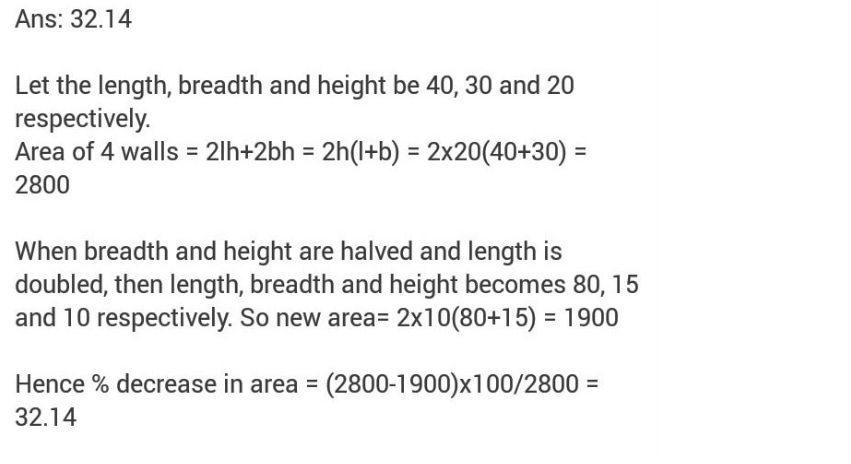
Assign a common multiplier k to the ratio 4 : 3 : 2, so length = 4k, breadth = 3k, height = 2k.
Original LSA = 2 x height x (length + breadth) = 2 x (2k) x (4k + 3k) = 4k x 7k = 28k2.
Apply the changes: length doubled = 8k, breadth halved = 1.5k, height halved = k.
New LSA = 2 x (new height) x (new length + new breadth) = 2 x (k) x (8k + 1.5k) = 2k x 9.5k = 19k2.
Decrease = 28k2 - 19k2 = 9k2; percentage decrease = (9k2 / 28k2) x 100 = (9/28) x 100 = 32.14%.
Cross-check
The k2 cancels, so the answer is scale-free: only the ratio matters. Check the new perimeter independently: 8k + 1.5k = 9.5k versus the old 7k, and the height fell from 2k to k, so LSA goes from 2 x (2k) x (7k) = 28k2 to 2 x (k) x (9.5k) = 19k2 - confirming a 9/28 = 32.14% drop.