Direction: In the question below are given three statements followed by two…
2026
Direction: In the question below are given three statements followed by two conclusions numbered I and II. You have to take the given statements to be true even if they seem to be at variance with commonly known facts. Read both conclusions and then decide which of them logically follows from the given statements, disregarding commonly known facts.
Statements:
All Peaks are Highways.
Some Forests are Highways.
All Roads are Highways.
Conclusions:
I. Some Roads are definitely Peaks.
II. Some Peaks are definitely not Forests.
- A.
Only conclusion I follows
- B.
Only conclusion II follows
- C.
Both conclusions I and II follow
- D.
Neither conclusion I nor II follows
Attempted by 7 students.
Show answer & explanation
Correct answer: D
Concept: In a syllogism solved by the Venn-diagram method, a conclusion is "definite" only if it is forced to be true in every diagram consistent with the given statements. To test any specific conclusion, try to construct one valid diagram — consistent with every statement — in which that conclusion is false. If such a diagram can be drawn, the conclusion is not definite, no matter how natural it may look in some other diagram. An "All A are B" statement fixes circle A fully inside circle B; a "Some A are B" statement only forces a partial overlap between A and B and leaves A's relationship with every other term completely open.
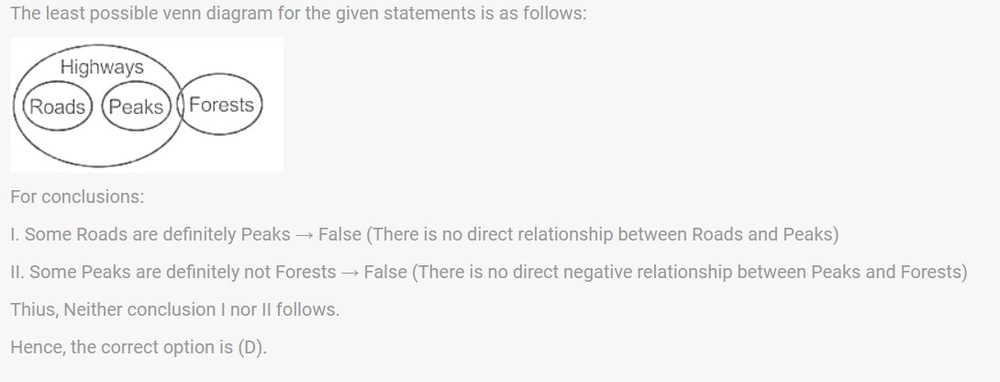
Peaks and Roads are each described only through "All ... are Highways", so draw both as separate circles sitting fully inside the Highways circle.
Neither statement links Roads to Peaks directly, so one valid diagram keeps the Roads circle and the Peaks circle completely apart inside Highways — in this diagram, conclusion I ("Some Roads are definitely Peaks") is false.
Since this diagram is consistent with all three statements yet makes conclusion I false, conclusion I is not forced to be true in every diagram — so it does not follow.
For conclusion II, try to construct a diagram where it is false: draw the Forests circle large enough to fully contain the entire Peaks circle, with that shared region still inside Highways (so "Some Forests are Highways" stays true) — in this diagram every Peak is also a Forest, making conclusion II ("Some Peaks are definitely not Forests") false.
This diagram, too, is consistent with all three statements, so conclusion II is not forced to be true in every diagram either — it does not follow.
Cross-check: one valid diagram keeps Roads and Peaks fully apart, defeating conclusion I; a second, equally valid diagram places every Peak inside Forests, defeating conclusion II — in fact both constructions can be combined into a single diagram where both conclusions fail together. Since a valid diagram falsifies each conclusion, neither is guaranteed by the statements, and neither follows.
Reference diagram: