Direction: Select the option that is true about the Statements and Conclusions…
2025
Direction: Select the option that is true about the Statements and Conclusions given:
Statements:
Some keys are levers.
Some levers are apples.
All apples are buttons.
Conclusions:
I) Some buttons are levers.
II) Some buttons are keys.
- A.
If only conclusion I follows
- B.
If only conclusion II follows
- C.
If both conclusion I and II follows
- D.
If none of the conclusion I and II follows
Attempted by 7 students.
Show answer & explanation
Correct answer: A
Concept: When one premise is particular ('Some A are B') and the other is universal ('All B are C'), they combine to give a particular conclusion, 'Some A are C', and a particular affirmative conclusion can always be converted the other way round ('Some C are A'). Two particular premises alone (two 'Some' statements) never yield any valid conclusion — at least one universal statement is required to link two classes.
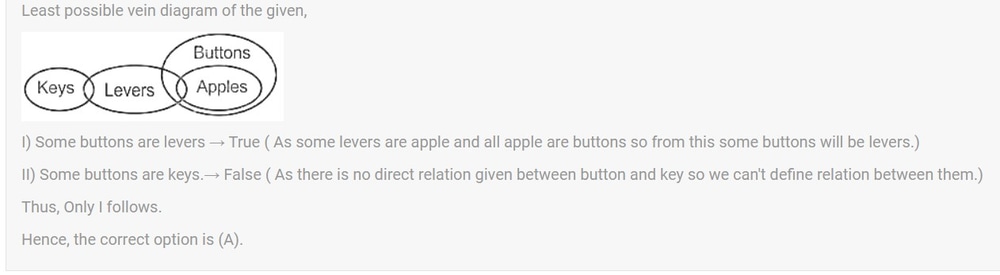
'Some levers are apples' (particular) combines with 'All apples are buttons' (universal), so a valid conclusion follows: 'Some levers are buttons.'
Converting this particular statement gives 'Some buttons are levers' — this is exactly Conclusion I, so it follows.
The only statement connecting keys to any other class is 'Some keys are levers' (particular). To reach keys and buttons we would need to chain two particular statements, and two particular premises never yield a valid conclusion. So no relationship between buttons and keys can be established — Conclusion II does not follow.
Cross-check: The least-possible Venn diagram above confirms this directly — the buttons circle overlaps the levers circle (validating Conclusion I) while the keys circle has no overlap at all with the buttons circle (Conclusion II fails).
Result: Only Conclusion I follows, so the correct choice is the one stating that only conclusion I follows.