Direction: In the following question below are given some statements followed…
2024
Direction: In the following question below are given some statements followed by some conclusions. Taking the given statements to be true even if they seem to be at variance from commonly known facts, read all the conclusions and then decide which of the given conclusion logically follows the given statements.
Statements:
I. All bags are tables.
II. No table is red.
Conclusions:
I. Some bags are red.
II. All bags are red.
- A.
Only conclusion I follows
- B.
Only conclusion II follows
- C.
Neither conclusion I nor conclusion II follows
- D.
Both conclusions follow
Attempted by 7 students.
Show answer & explanation
Correct answer: C
In syllogism problems, a conclusion follows only when it holds true in every diagram consistent with the given statements. When one category has zero overlap with a second category, any category that sits entirely inside the first one also ends up with zero overlap with the second — the exclusion carries downward through containment.
Statement I says all bags are tables, so the 'bags' category sits entirely inside the 'tables' category.
Statement II says no table is red, so the 'tables' category has zero overlap with the 'red' category.
Since 'bags' sits entirely inside 'tables', and 'tables' has zero overlap with 'red', 'bags' also has zero overlap with 'red' — no bag can be red.
Conclusion I claims some bags are red, a partial overlap between bags and red — this contradicts the zero-overlap relation just derived, so it does not follow.
Conclusion II claims all bags are red, a full overlap between bags and red — this also contradicts the zero-overlap relation, so it does not follow either.
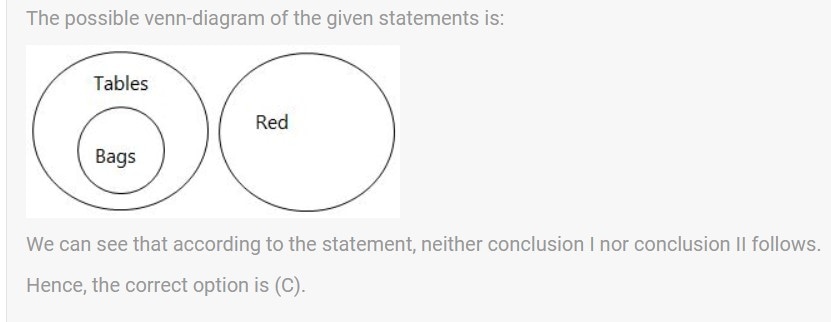
Drawing the three categories confirms this: the 'tables' circle is drawn with no overlap at all with the 'red' circle, and the 'bags' circle is drawn entirely inside 'tables'. In every diagram obeying both statements, 'bags' and 'red' end up completely separate, so neither conclusion can be forced true.
Since neither the partial-overlap conclusion nor the full-overlap conclusion is forced by the statements, the option stating that neither conclusion follows is the one that holds.