Direction: In the question below are given three statements followed by two…
2025
Direction: In the question below are given three statements followed by two conclusions numbered I, and II .You have to take the given statements to be true even if they seem to be at variance with commonly known facts. Read all the conclusions and then decide which of the given conclusions logically follows from the given statements disregarding commonly known facts.
Statements:
A few Table are Chair
No Chair is Charger
Some Charger are Laptop
Conclusions:
I. Some Table can never be Charger
II. Some Laptop are Table
- A.
Only I follows
- B.
Only II follows
- C.
Both I and II follow
- D.
Either I or II follows
Attempted by 8 students.
Show answer & explanation
Correct answer: A
Concept: In syllogism, when a Particular Affirmative statement ('Some A are B') and a Universal Negative statement ('No B is C') share the same middle term B, the portion of A that overlaps with B is automatically excluded from C — so 'Some A can never be C' is a valid conclusion. But if two end-terms are connected only through a middle term that never states or forces a direct relationship between them, no conclusion linking those two end-terms can be drawn, however tempting the chain looks.
Application:
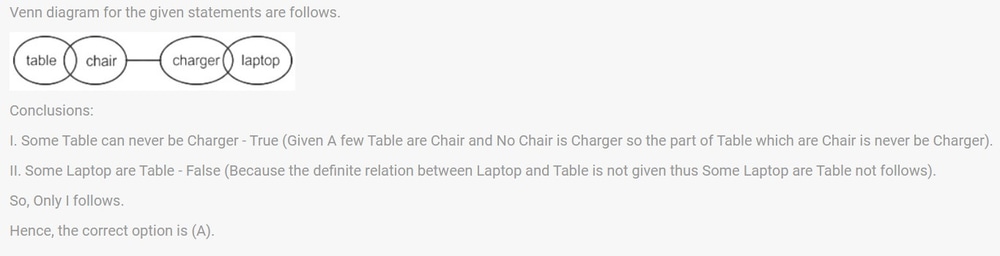
"A few Table are Chair" establishes that the Table circle and the Chair circle overlap in at least one region.
"No Chair is Charger" makes the Chair circle and the Charger circle completely separate — zero overlap anywhere.
Since the Table-Chair overlap sits entirely inside the Chair circle, and the Chair circle has no overlap with Charger at all, that same overlap region is guaranteed to fall outside Charger too — this directly validates the first conclusion ("Some Table can never be Charger").
"Some Charger are Laptop" connects only Charger with Laptop — it never touches Table, and Table only reaches as far as Chair. So no premise, direct or chained, links Laptop with Table, and the second conclusion ("Some Laptop are Table") does not follow.
Cross-check: Drawing the three circles confirms it — Table and Chair overlap, and that entire overlapping patch sits outside the disjoint Charger circle, so the first conclusion always holds in every valid diagram. Table and Laptop, however, can be drawn overlapping or completely apart across different equally valid diagrams, since no statement forces either outcome — so the second conclusion is not guaranteed and does not follow.
Result: Only the conclusion "Some Table can never be Charger" follows.
Venn diagram representation: