Direction: In the question below are given two statements followed by two…
2026
Direction: In the question below are given two statements followed by two conclusions numbered I and II. You have to take the given statements to be true even if they seem to be at variance with commonly known facts. Read both conclusions and then decide which of the given conclusions logically follows from the given statements, disregarding commonly known facts.
Statements:
All Groups are People.
Only a Few People are Person.
Conclusions:
I. Some People are Groups.
II. Some People are not Person.
- A.
Only I follow
- B.
Only II follows
- C.
Both I and II follow
- D.
Either I or II follows
Attempted by 9 students.
Show answer & explanation
Correct answer: C
Concept: A universal affirmative statement of the form ‘All A are B’ always converts to the particular statement ‘Some B are A’ (conversion by limitation). A partial-overlap statement of the form ‘Only a Few A are B’ is read as a fixed particular pair: ‘Some A are B’ AND ‘Some A are not B’, both guaranteed by definition. A conclusion follows only if it holds in every diagram consistent with the statements — the least possible Venn diagram (drawing only the overlaps the statements force, keeping everything else separate) is the standard check for this.
Application:
‘All Groups are People’ places the Groups circle entirely inside the People circle.
By conversion of this universal statement, ‘Some People are Groups’ is forced to be true in every valid diagram — this is Conclusion I.
‘Only a Few People are Person’ is a partial-overlap statement: it fixes both ‘Some People are Person’ and ‘Some People are not Person’ as true, without deciding how the Person circle relates to the Groups circle.
The ‘Some People are not Person’ half of that pair is exactly Conclusion II, so it too is forced to be true in every valid diagram.
The least possible diagram keeps the Person circle away from the Groups circle, since nothing in the statements forces them to meet — giving the diagram shown below.
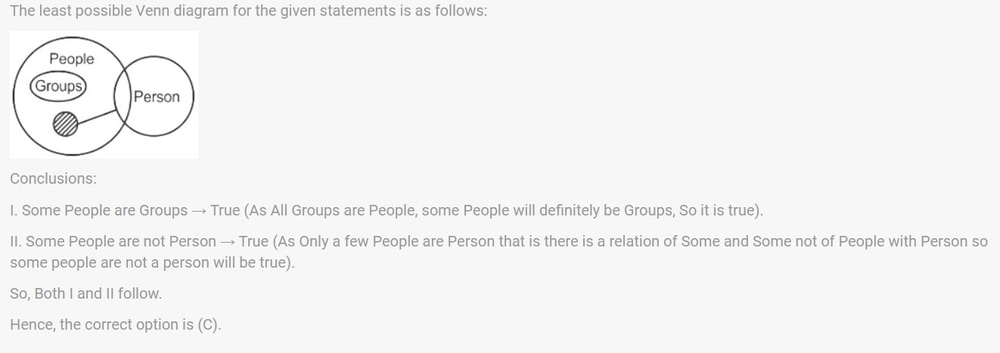
Cross-check: Redraw the diagram with the Person circle also overlapping the Groups circle. People must still contain members outside Person to satisfy ‘only a few’, so Conclusion II still holds; and the conversion behind Conclusion I never depended on the Groups-Person relationship at all. Both conclusions hold across every diagram consistent with the statements.
Hence, both Conclusion I and Conclusion II follow.