Direction: In the question below are given two statements followed by two…
2025
Direction: In the question below are given two statements followed by two conclusions numbered I and II. You have to take the given statements to be true even if they seem to be at variance with commonly known facts. Read all the conclusions and then decide which of the given conclusions logically follows from the given statements, disregarding commonly known facts.
Statements:
All jets are planes.
Only a few planes are domestic.
Conclusions:
I. Some jets are domestic.
II. No jet is domestic.
- A.
Only I conclusion follows
- B.
Only II conclusion follows
- C.
Either I or II conclusion follows
- D.
Neither I nor II conclusion follows
Attempted by 41 students.
Show answer & explanation
Correct answer: C
Concept: In syllogism items solved through Venn-diagram possibilities, a conclusion is valid only if it stays true in every diagram consistent with the given statements — not just one. When two conclusions about the same pair of terms state a 'some' relationship and its exact opposite 'no' relationship, and every valid diagram forces exactly one of the two to hold, the two conclusions form a complementary pair: individually neither is certain, but together they are a definite outcome.
Application: Apply this to the given statements:
'All jets are planes' fixes the jets group as a portion lying entirely inside the planes group.
'Only a few planes are domestic' fixes the domestic planes as a genuine part of the planes group (some planes are domestic, and, since it is 'only a few', some planes are not) — it fixes nothing about how this domestic part sits relative to the jets group specifically.
Draw a diagram with the jets group placed entirely inside the domestic part of planes: here 'some jets are domestic' holds, and 'no jet is domestic' fails.
Draw a second diagram with the jets group placed entirely outside the domestic part of planes: here 'no jet is domestic' holds, and 'some jets are domestic' fails.
Since each conclusion is true in one of these diagrams and false in the other, neither conclusion holds in every valid diagram, so neither follows on its own.
The diagram below shows one such valid layout:
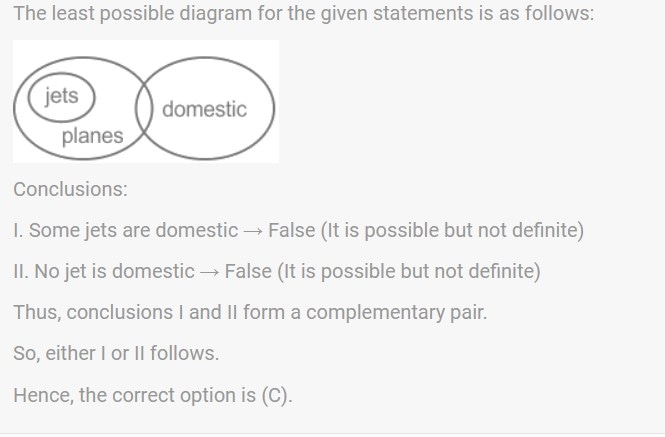
Cross-check: Try a third diagram where the jets group partially overlaps the domestic part of planes: 'some jets are domestic' is true again, and there remains no diagram where both conclusions fail together — confirming the two conclusions are an exhaustive, mutually exclusive pair between jets and domestic.
Result: Because exactly one of the two conclusions is always true across every valid diagram, they form a definite pair — either I or II conclusion follows.