What number will come immediately before 63 in the given sequence? 1, 2, 3, 7,…
2025
What number will come immediately before 63 in the given sequence? 1, 2, 3, 7, 7, 22, 15, 67, ........
- A.
48
- B.
202
- C.
403
- D.
601
Attempted by 19 students.
Show answer & explanation
Correct answer: B
Concept:
This is an interleaved (alternating) series — two independent numeric chains occupy alternating positions within one visible sequence. To extend such a series, split it by position parity into its two component chains, identify each chain's own arithmetic rule, and then apply that rule to each chain separately.
Application:
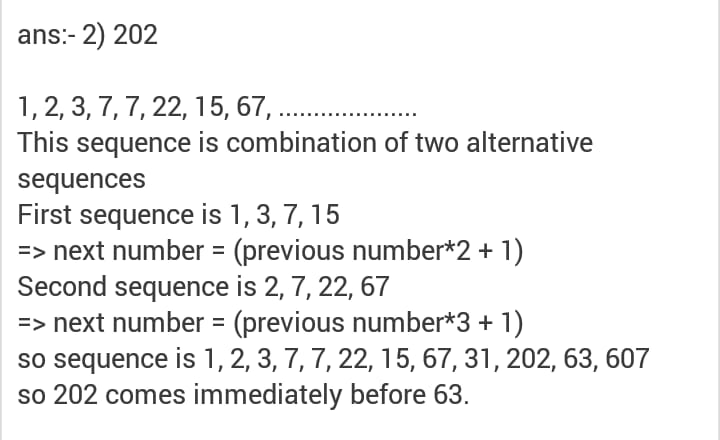
Split the 8 given terms by position — odd positions (1st, 3rd, 5th, 7th): 1, 3, 7, 15; even positions (2nd, 4th, 6th, 8th): 2, 7, 22, 67.
Odd-position chain rule — each term = previous term × 2 + 1: 1×2+1=3, 3×2+1=7, 7×2+1=15.
Even-position chain rule — each term = previous term × 3 + 1: 2×3+1=7, 7×3+1=22, 22×3+1=67.
Extend the odd-position chain: 9th term = 15×2+1 = 31; 11th term = 31×2+1 = 63.
Extend the even-position chain: 10th term = 67×3+1 = 202.
So the merged series continues …, 15 (7th), 67 (8th), 31 (9th), 202 (10th), 63 (11th), … — the term immediately before 63 is the 10th term.
Cross-check:
Both chains hold internally all the way through — odd-position chain 1, 3, 7, 15, 31, 63 (each term = previous × 2 + 1); even-position chain 2, 7, 22, 67, 202 (each term = previous × 3 + 1). Since 63 is the 11th (odd-position) term, its immediate predecessor in the merged series is the 10th (even-position) term, 202.