Select the alphanumeric cluster that can replace the question mark (?) in the…
2024
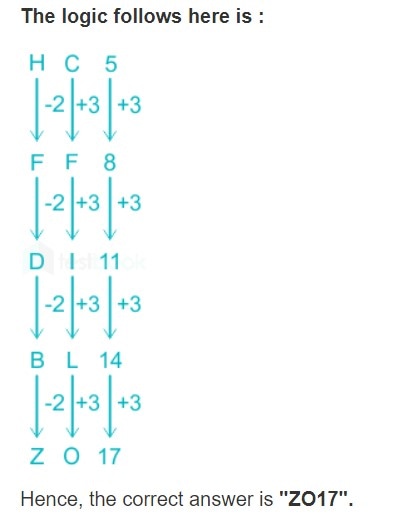
Select the alphanumeric cluster that can replace the question mark (?) in the following series: HC5, FF8, DI11, BL14, ?
- A.
ZO17
- B.
ML12
- C.
OX15
- D.
YX17
Attempted by 74 students.
Show answer & explanation
Correct answer: A
An alphanumeric series built from multi-part clusters (letter-letter-number) is really three independent series running in parallel — one for each position in the cluster. Each parallel series keeps its own constant step: a fixed number of alphabet positions for a letter series (A = 1 through Z = 26, wrapping around at the ends), or a fixed arithmetic difference for a numeric series. Solving the series means isolating each position into its own sub-sequence, finding that position's own constant step from the given terms, and then applying that same step once more to get the next cluster.
Split every term into its three parts — leading letter, middle letter, and trailing number: HC5 → (H, C, 5); FF8 → (F, F, 8); DI11 → (D, I, 11); BL14 → (B, L, 14).
Track the leading letters alone: H, F, D, B. Converting to alphabet positions (A=1 … Z=26) gives 8, 6, 4, 2 — a constant step of −2 at every gap.
Track the middle letters alone: C, F, I, L. Their positions are 3, 6, 9, 12 — a constant step of +3 at every gap.
Track the trailing numbers alone: 5, 8, 11, 14 — also a constant step of +3 at every gap.
Apply each sub-sequence's own step once more to its last term: the leading letter's position goes 2 − 2 = 0, which wraps past the start of the alphabet to position 26 (Z); the middle letter's position goes 12 + 3 = 15 (O); the trailing number goes 14 + 3 = 17.
Recombine the three results in order — leading letter, middle letter, number — to get the next cluster.
Re-deriving each sub-sequence independently confirms the same three constant steps hold across all four given terms with no exception (−2 for the leading letter, +3 for the middle letter, +3 for the number), so applying those same steps one more time is a reliable continuation rather than a coincidental fit.
The next cluster in the series is the one that matches all three of these continued steps together.