Comprehension:Directions: Study the following statements carefully and answer…
2026
Comprehension:Directions: Study the following statements carefully and answer the given questions.Following are the conditions for selecting a candidate for MBA in a top college-The candidate must-i) Be not more than 25 years of age on 1 August 2017.ii) Be a 10th pass with minimum 80% marks.iii) Be a 12th pass in any discipline with minimum 70% marks.iv) Have secured minimum 70% in Group Discussion.v) Have secured minimum 60% in Personal Interview.In the case of candidate who fulfils all the conditions except ____a) At iii) above, but has secured at least 60% in class 12th but had science in class 12th his/her case is to be referred to department head of MBA.b) At v) above, but has secured at least 50% in Personal Interview his/her case is to be referred to admissions committee.In each question below, details of one candidate are provided. You have to take one of the following courses of actions based on the conditions given above and the information provided in each question and mark the number of that course of action as your answer. You are not to assume anything other than the information provided in each question. All these cases are given to you as on 1 August 2017.Now read the information provided in each question and mark your answer accordingly.Dikshant Tanwani scored 67% in12th in science stream and 92% in 10th class. He scored 85% in Personal Interview and 82% in Group Discussion. He was born on 12th September 1995.
- A.
Data provided are inadequate to take a decision.
- B.
Candidate is not to be selected.
- C.
Candidate is to be selected.
- D.
Case is to be referred to department head of MBA.
Attempted by 646 students.
Show answer & explanation
Correct answer: D
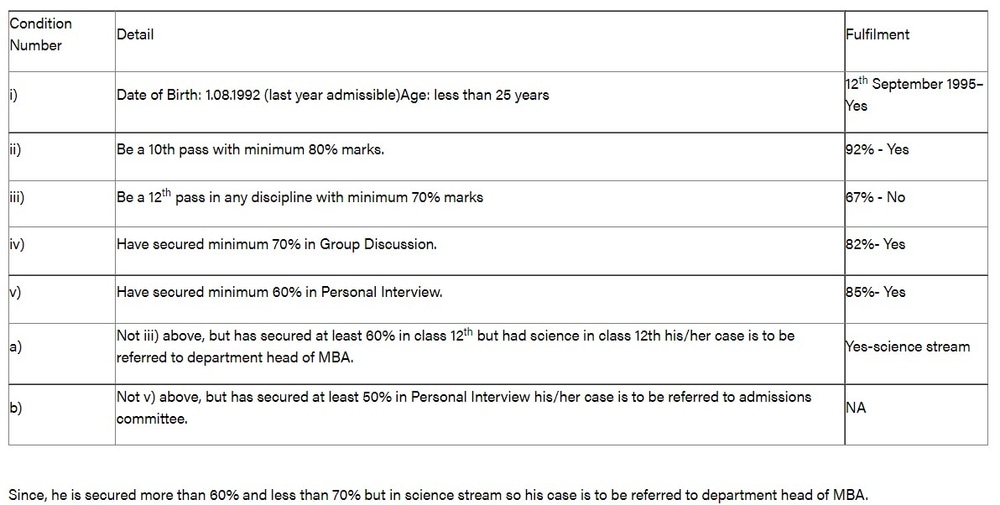
Concept: For a “course of action” comprehension set like this one, first test the candidate against every numbered main condition (i–v). A candidate who satisfies all five gets the plain select/reject verdict stated for that outcome. A candidate who fails exactly one condition must then be checked against the passage's own named exception clauses — each exception carries its own separate numeric floor and its own separate resulting action, and it overrides the blanket select/reject verdict when its floor is met. Wherever an age condition is illustrated with a cut-off date (a threshold set a fixed number of years before the reference date), that cut-off is only a comparison benchmark — it is never the candidate's own date of birth, which must be read from the candidate's stated details.
Application:
Age (condition i): Reference date is 1 August 2017. Dikshant's own date of birth is 12 September 1995 — this is the figure to use, not any cut-off date shown alongside the condition (a cut-off date only marks the earliest birth date that still counts as under 25 on the reference date). Since 12 September 1995 is later than that cut-off, he is under 25 on 1 August 2017 → condition (i) is satisfied.
10th marks (condition ii): 92%, which is ≥ 80% → satisfied.
12th marks and stream (condition iii): 67% in science stream, which is below the required 70% → NOT satisfied outright.
Group Discussion (condition iv): 82%, which is ≥ 70% → satisfied.
Personal Interview (condition v): 85%, which is ≥ 60% → satisfied.
Cross-check: Only condition (iii) is unmet, and every other condition is clearly satisfied, so this is a single-exception case. Testing that one shortfall against the passage's two named exception clauses — clause (a) for a 12th-marks shortfall paired with a science stream at ≥60%, clause (b) for a Personal-Interview shortfall — Dikshant's 67% in the science stream clears clause (a)'s own floor, so the action named in clause (a) is the one that applies to his case, confirming the answer above matches the source answer key.