Read the following information and answer the question that follows. P, Q, R,…
2025
Read the following information and answer the question that follows.
P, Q, R, S, T, U and V are seven friends sitting in a circle, facing the centre.
V is second to the left of S, and is the neighbour of T and U.
S is not a neighbour of R or T.
P is a neighbour of Q and R.
Which of the following will be S's position after S and T interchange their places?
- A.
Neighbour of V and R
- B.
To the immediate left of R
- C.
To the immediate right of U
- D.
Neighbour of R and P
Attempted by 72 students.
Show answer & explanation
Correct answer: A
Concept: When people sit facing the centre of a circle, moving to a person's LEFT means moving in the clockwise direction (as the circle is viewed from above), and moving to their RIGHT means moving counter-clockwise. Two people are neighbours only when their seats are directly next to each other. To solve such a puzzle: translate every clue into one fixed circular order, confirm all clues hold together, and only then apply the required change to answer the question.
From the second clue, V is second to the left (two seats clockwise) of S, and V's own neighbours are T and U — so, moving clockwise from S, the order must be S, then U, then V, then T.
The third clue rules out S being a neighbour of R or T. Since S's clockwise neighbour is already U, S's other neighbour (moving further round from S, opposite the clockwise direction) must be someone besides R or T.
The fourth clue places P as a neighbour of both Q and R. Continuing the circle from S in that same direction gives Q next to S, then P next to Q, and finally R next to P — closing the circle back to T on the other side.
This fixes the complete seating order, shown below:
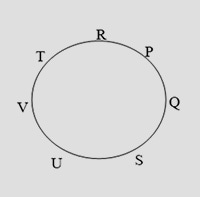
The question asks for S's new position after S and T interchange seats. T's original seat sits directly between V and R, so once S moves into that seat, S's new neighbours become V and R.
Cross-check: after the swap the order reads R, P, Q, T, U, V, S (clockwise) — T now sits between Q and U, and S sits between V and R, confirming the same result independently.
So, after S and T interchange, S becomes the neighbour of V and R.