Read the following information carefully and answer the question that follows.…
2024
Read the following information carefully and answer the question that follows. (Questions 9 to 11 are based on this information.)
P, Q, R, S, T, U and V are seven friends sitting in a circle, facing the centre.
V is second to the left of S, and is the neighbour of T and U.
S is not a neighbour of R or T.
P is a neighbour of Q and R.
Which of the following is correct?
- A.
Q is between P and S.
- B.
S is between U and P.
- C.
T is to the immediate right of V.
- D.
U is to the immediate left of V.
Attempted by 3 students.
Show answer & explanation
Correct answer: A
In a circular arrangement where everyone faces the centre, positions are read using each person's own left and right: as drawn, moving clockwise around the circle is a seated person's left-hand direction, and moving counter-clockwise is their right-hand direction. "Second to the left of X" means two seats clockwise from X, and two people are neighbours only when their seats are immediately adjacent.
Number the seats 1 to 7 clockwise and place S at seat 1. Since V is second to the left of S, V takes seat 3; V's two neighbours (seats 2 and 4) must be T and U, in some order.
S is not a neighbour of R or T. S's neighbours are seats 2 and 7, so seat 2 cannot be T — seat 2 is U and seat 4 is T. Seat 7, S's other neighbour, also cannot be R.
P, Q and R fill the remaining seats 5, 6 and 7. Since P is a neighbour of both Q and R, P must sit between them, taking the middle seat 6, with Q and R at seats 5 and 7.
Seat 7 cannot be R (from the previous step), so R takes seat 5 and Q takes seat 7. The complete clockwise order is: S - U - V - T - R - P - Q - back to S.
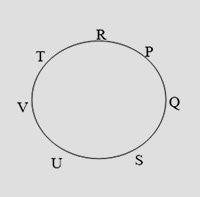
Reading neighbours off this order: Q's neighbours are P and S, so a claim pairing Q with both of them holds. S's neighbours are U and Q, not P, so any claim placing P next to S fails. Around V, the clockwise (left-hand) neighbour is T and the counter-clockwise (right-hand) neighbour is U, so a claim that swaps these two sides is reversed.
Hence, only the claim that Q sits between P and S is correct.