Choose the correct option.
2024
Choose the correct option.
- A.
A
- B.
B
- C.
C
- D.
D
- E.
E
Attempted by 23 students.
Show answer & explanation
Correct answer: B
Concept: In a multi-attribute figural sequence, each visual attribute of the figure — such as a corner shape, a centre shape, and a comparison symbol — typically follows its own independent rule (a steadily changing count, an alternation between two fixed states, or a comparison between two other attributes), and the next figure in the sequence must satisfy every one of those independent rules at the same time, not just one of them.
Applying this to the given sequence:
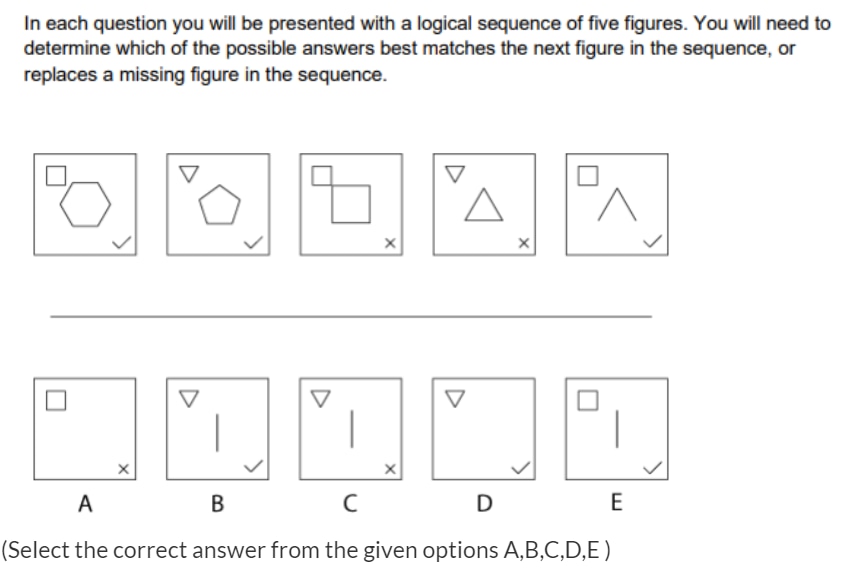
The centre shape across the five given figures has 6, 5, 4, 3, and 2 sides in turn (hexagon, pentagon, a four-sided outline, triangle, and a two-line angle) — the count drops by exactly one side at every step, so the sixth figure's centre shape must have one side, i.e. a single straight line.
The top-left corner shape across the five given figures alternates: square, triangle, square, triangle, square — a strict flip-flop every step. Since the fifth figure shows a square, the sixth figure's top-left shape must switch to the triangle.
The tick/cross symbol compares the number of sides of the top-left shape with the number of sides of the centre shape: it is a cross whenever the two counts are equal, and a tick whenever they differ. This holds across all five given figures — for example the third figure has a square (4 sides) alongside a four-sided centre shape (4 sides, equal, cross), while the first figure has a square (4 sides) alongside a hexagon (6 sides, different, tick).
Cross-check: Applying the comparison rule to the derived sixth figure: a triangle has 3 sides and a single line has 1 side — these counts differ, so the symbol rule independently confirms a tick as well. All three independent rules agree on exactly one combination.
The next figure in the sequence therefore has a triangle at top-left, a single straight line at the centre, and a tick.