All of the following questions consists of two sets of figures. Figures A, B,…
2025
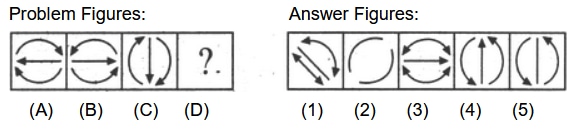
All of the following questions consists of two sets of figures. Figures A, B, C and D constitute the Problem Set while figures 1, 2, 3, 4 and 5 constitute the Answer Set. There is a definite relationship between figures A and B. Establish a similar relationship between figures C and D by selecting a suitable figure from the Answer Set that would replace the question mark (?) in fig. (D). Select a suitable figure from the Answer Figures that would replace the question mark (?).
- A.
1
- B.
2
- C.
3
- D.
4
- E.
5
Attempted by 23 students.
Show answer & explanation
Correct answer: D
In a figure-analogy (pattern-completion) series, first find the single transformation rule that turns Problem Figure A into Problem Figure B. Apply that exact same rule to Problem Figure C to derive the missing Figure D.
Figure A: two curved arrows form a circle rotating in one direction, together with a straight horizontal arrow pointing left.
Figure B: the same circle now rotates in the opposite direction, and the straight horizontal arrow now points right — both the curved arrows and the straight arrow have reversed, while the horizontal orientation stays the same.
Rule (A to B): reverse the rotation of the curved arrows AND reverse the direction of the straight arrow, while keeping the same orientation of the figure.
Figure C: the circle is now oriented vertically, with the curved arrows rotating in one direction and a straight vertical arrow pointing down.
Applying the same rule to Figure C: the curved arrows must reverse their rotation, and the straight arrow must now point up, while the orientation stays vertical.
Cross-check: among the Answer Figures, only one keeps the vertical orientation set by Figure C, reverses the rotation of both curved arrows relative to Figure C, and shows the straight arrow pointing upward — satisfying all three conditions of the rule at once.