In the following question, which pattern will the given sheet resemble when it…
2026
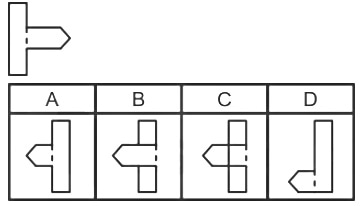
In the following question, which pattern will the given sheet resemble when it is folded at the dotted line? (Sheet is transparent.)
- A.
D
- B.
A
- C.
B
- D.
C
Attempted by 53 students.
Show answer & explanation
Correct answer: D
Concept: A fold is a reflection across the crease line. Every point of the folded flap keeps its distance from the crease and simply flips to the other side of it, so its position ALONG the crease is unchanged -- only the side it sits on and its direction reverse. When the sheet is transparent, folding does not hide anything: wherever the reflected flap lands on top of the base sheet, both layers stay visible together, so the base sheet's own edge at the crease still shows through as a second outline crossing the flap.
Applying it to this sheet:
The crease (dotted line) here is vertical, at the point where the right-pointing flag joins the tall bar, roughly a third of the way down from the top.
Reflecting the flag across this vertical crease reverses only its left-right direction: the point that faced right now faces left. Because the crease is vertical, the flag's height along the bar does not shift up or down.
The reflected flag now lies on the same stretch of the bar it was attached to, at that same height, on the bar's left side.
Since the sheet is transparent, the bar's original edge at that crease remains visible under the reflected flag, so the flag's outline and the bar's edge cross one another there instead of meeting as a single clean line.
Cross-check by ruling out the others:
The pattern with the flag pushed up to the very top of the bar moves the fold to the wrong height -- a fold about this crease cannot relocate the flap away from where it was actually attached.
The pattern at the correct height but drawn with the flag and bar meeting as a single clean edge treats the sheet as opaque, which contradicts the given transparency -- the underlying edge should still show through.
The pattern with a shorter bar and the flag rotated to point down-left reconstructs a different shape altogether; a single straight vertical crease can only mirror the flag left-right at its existing height, not rotate it or move it to a new edge.
Only the pattern that keeps the flag at the same height as the original crease AND shows the bar's edge crossing through the reflected flag (the transparency effect) matches -- that is pattern C.