A piece of paper is folded and punched as shown in the question figure. From…
2026
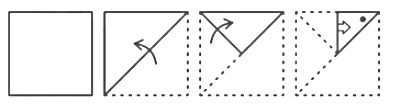
A piece of paper is folded and punched as shown in the question figure. From the given answer figures, indicate how it will appear when opened?
Attempted by 50 students.
Show answer & explanation
When a folded sheet is punched, the punch passes through every layer stacked at that point. Unfolding reverses the folds one at a time, and each punch mark is reflected across the crease being undone — a plain dot reflects to another plain dot, but a directional mark like an arrow reflects into an opposite-facing mirror image, so two such mirrored copies meeting at a crease read as a single double-headed arrow.
Fold 1 brings the square's bottom-right corner up onto its top-left corner along the main diagonal, leaving a right-angled triangular half of the sheet.
Fold 2 halves this triangle again, producing a smaller triangle that is one quarter of the original square, with four layers stacked at the corner that was originally a corner of the square.
A round dot and an arrow-shaped mark are punched together near that four-layer corner, as shown.
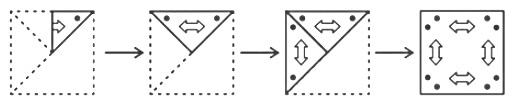
Unfolding fold 2 reflects both marks across that crease: the dot gains a mirror twin, and the arrow gains an opposite-facing twin, so the two arrow copies together form a double-headed arrow.
Unfolding fold 1 reflects this whole pattern across the main diagonal; because that crease runs at 45 degrees, it swaps horizontal and vertical directions, so a double-headed arrow that pointed left-right on one side reappears pointing up-down on the other side, while every dot again gains a mirror twin near the remaining corners.
The fully opened sheet must therefore show a mirrored pair of dots tucked just inside the two edges meeting at every one of the four corners, a horizontal double-headed arrow at the middle of the top and bottom edges, and a vertical double-headed arrow at the middle of the left and right edges — never single, unpaired corner dots (that would mean a layer's mark was dropped), and never the arrows swapped onto the wrong edges, since the diagonal fold always exchanges horizontal and vertical directions and can never leave them as they were.
This is the pattern shown in the figure with two dots at every corner, a horizontal double-headed arrow on the top and bottom edges, and a vertical double-headed arrow on the left and right edges.