The sequence of folding a piece of paper and the manner in which the folded…
2025
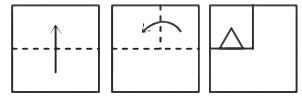
The sequence of folding a piece of paper and the manner in which the folded paper has been cut is shown in the following figures. How would this paper look when unfolded?
Attempted by 48 students.
Show answer & explanation
Unfolding any crease reflects the entire folded cut region across that crease's line, producing a mirror-image copy — this reflection happens for every crease that gets undone, regardless of whether the cut touches that particular crease. What touching a crease determines is whether the original piece and its new mirror copy share an edge along that crease (and so fuse into one continuous shape), or remain two separate, disconnected copies with a gap between them.
First fold: the bottom half is folded up over the top half along a horizontal line — this line is crease 1.
Second fold: the right half of the folded strip is folded over the left half along a vertical line — this line is crease 2.
The cut made on this folded packet is a triangle (apex up) whose base lies exactly on crease 1, centred between the side edges — it touches crease 1 but stops short of crease 2.
Unfold crease 2 first (the last fold made, so the first to reopen): the triangle mirrors across the vertical line, giving two apex-up triangles side by side, both still resting on crease 1.
Unfold crease 1: each apex-up triangle mirrors across the horizontal line into an apex-down triangle directly beneath it. Since the shared base sits exactly on crease 1, each up/down pair joins along that base into one diamond shape.
Check: unfolding crease 2 always doubles the single cut into two copies (regardless of touching), giving the two triangles side by side; unfolding crease 1 then doubles again — but because the cut's base sits exactly on crease 1, each triangle fuses with its own mirror copy along that shared base into one diamond, rather than the two doublings multiplying into four separate triangles. Two diamonds is therefore correct — not a 2x2 grid of four disconnected triangles (which would need the cut to be pulled away from crease 1 too) and not a single row of two triangles (which would mean the second fold, crease 2, was never reopened).
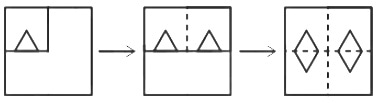
The fully unfolded sheet therefore shows two diamond shapes placed side by side, symmetric about both centre lines of the sheet.