The sheet below is folded twice along the dotted lines, and a design is then…
2026
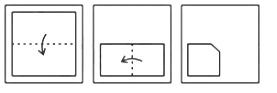
The sheet below is folded twice along the dotted lines, and a design is then cut into the folded sheet at the final step (see the figure). Predict how this design will appear when the sheet is fully unfolded.
Attempted by 44 students.
Show answer & explanation
Concept: A cut made through several folded layers cuts every layer along the same path at once. Unfolding is nothing but reflecting each layer back across the crease it was folded along — a cut positioned exactly on a crease reflects into a symmetric shape straddling that crease, and a cut sitting at the point where two creases intersect reflects across both creases, so its mirrored copies meet exactly at that intersection and merge into one single symmetric shape centred there.
Application: Here the square is folded top-half down onto the bottom half along the first (horizontal) crease, then the resulting rectangle is folded right-half onto the left half along the second (vertical) crease. The folded packet's top edge is therefore the horizontal crease and its right edge is the vertical crease — so the corner where these two edges meet is exactly the centre of the original square. The diagonal corner-cut made on the folded packet sits precisely on this corner, i.e. exactly on both creases at once. Unfolding the vertical crease reflects the notch left-right about the centre; unfolding the horizontal crease then reflects it top-bottom about the centre too. The four reflected notches meet edge-to-edge and combine into one diamond (rhombus) shape sitting exactly in the middle of the fully opened sheet.
Cross-check — why not the others:
Two shapes stacked one above the other (upper and lower) would appear only if the corner sat on the vertical crease but away from the horizontal crease — the vertical crease would still merge the mark into a single column, while the horizontal fold, not touching it, would duplicate that column into a copy above the centre and a copy below it.
Two shapes side by side (left and right) would appear only if the corner sat on the horizontal crease but away from the vertical crease — the horizontal crease would still merge the mark into a single row, while the vertical fold, not touching it, would duplicate that row into a copy left of the centre and a copy right of it.
An upright, non-rotated square copied to the centre would appear only if the cut were simply carried over as-is without being mirrored about either crease — but reflecting a cut through folded layers always repositions it via mirror reflection about each crease in turn, so it does not remain a plain upright shape like this.
So once fully opened out, the sheet shows a single diamond-shaped mark at the exact centre of the square.