paper is folded and cut as shown below. How will it appear when unfolded?
2024
paper is folded and cut as shown below. How will it appear when unfolded?
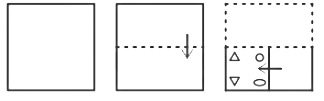
Attempted by 34 students.
Show answer & explanation
Concept: When a folded stack of paper is cut, the same cut passes through every layer at once. Unfolding reverses the folds one at a time: reflecting a mark across a fold line reverses only the part of its shape running perpendicular to that line — so a triangle's up/down-pointing apex flips to the opposite direction when mirrored across a horizontal crease — while any part running parallel to the line, or a shape that already looks identical from both sides of it (such as a circle or an oval), reappears unchanged. A fold running the other way (left-right) is perpendicular to a triangle's left-right extent, not its up/down point, so it never reverses the triangle's up/down direction, since flipping left-to-right leaves an upward or downward point untouched.
Application: Here the sheet is folded top-to-bottom and then right-to-left, and the triangle, circle, and oval marks are cut through the folded layers together, as shown.
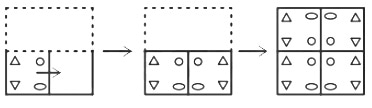
Unfolding the right-to-left fold first reproduces the marks unchanged on the newly revealed side — the triangles keep the same direction, and the circle and oval are unaffected. Unfolding the remaining top-to-bottom fold then reverses only the direction of the triangles on the rows it newly reveals, while every circle and oval stays exactly as it was.
Carrying this through row by row produces a fully opened sheet whose outer edge columns carry triangles that alternate direction going down the page — pointing up, then down, then up, then down — while the oval mark sits in the topmost and bottommost rows and the plain circle sits in the two middle rows.
Cross-check: unfolding the same two creases in the opposite order (top-to-bottom first, then right-to-left) reverses the same marks by the same rule and produces the identical final sheet, confirming the result does not depend on which fold is opened first.