A square transparent sheet with a pattern is given. How will the pattern…
2024
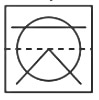
A square transparent sheet with a pattern is given. How will the pattern appear when the transparent sheet is folded along the dotted line?
Attempted by 43 students.
Show answer & explanation
Concept
When a transparent sheet is folded along a straight line, every mark on one side of that line reflects onto the same position on the other side, mirrored across the line. Because the sheet stays see-through, the folded view shows the marks that stayed in place together with the mirror image of the marks that got folded over, joined wherever the original pattern actually crossed the fold line.
Applying it here
In the given sheet, the fold line runs straight through the exact centre of the circle, so it splits the circle's own outline into two equal arcs, one on each side. Above the fold line there is also a plain straight horizontal line drawn inside the circle. Below the fold line, a two-legged angular shape has its single vertex sitting exactly on the fold line, with its two straight legs running outward and down, crossing the circle's lower arc on their way to the edge of the sheet.
Folding the lower half up: the lower arc, being an equal mirror half of the same circle about the same centre line, lands exactly on the upper arc, so the circle's boundary still reads as one single curve, not two. The straight horizontal line stays exactly as it was, since it never left the retained half. The two-legged shape's vertex stays pinned to the fold line, and its two legs now rise upward and outward at the same angle as before, crossing the arc and the horizontal line at the same two points, mirror-positioned above the line.
Cross-check
Because the fold line is a true diameter of the circle, reflecting one semicircle can only ever retrace the other semicircle — any option that shows two separate, closely spaced curves for the boundary has added an arc that folding cannot produce. Because the horizontal line lies wholly on the retained side, it must survive untouched — any option that drops it has lost part of the original pattern. And because the angular shape's vertex sits on the fold line with two legs of equal length on either side, its reflection must keep both legs, of matching length, meeting at that same vertex — an option missing one leg, or with legs of visibly unequal length, breaks the sheet's own symmetry.