The sequence of folding a piece of square paper and the manner in which the…
2025
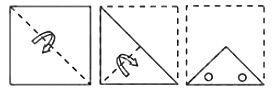
The sequence of folding a piece of square paper and the manner in which the folded paper has been cut is shown in the figures. How would this paper look when unfolded?
Attempted by 44 students.
Show answer & explanation
Concept: A cut made through several folded layers cuts every layer along the same path at once. Unfolding is nothing but reflecting each layer back, in reverse order, across the crease it was folded along. A cut placed exactly on a crease reflects into a single symmetric shape straddling that crease, while a cut placed away from every crease produces one separate mirror image per layer -- with two independent folds (four layers), a punch that touches neither crease yields four separate holes once the sheet is fully unfolded.
Application: Here the square is first folded along one diagonal, bringing one triangular half exactly over the other; the resulting right-angled triangle is then folded again along its own axis of symmetry, which is exactly the square's other diagonal, bringing its two remaining loose corners together. Two folds leave the final triangle four layers thick, with its two slanted sides being the two closed diagonal creases, and its base being the edge along which the square's four corners now meet in two coincident pairs, one pair sitting at each end of that base. The two punches shown near that base sit clear of both creases: one lies closer to one end of the base, the other closer to the far end. Unfolding the second crease mirrors each punch once; unfolding the first crease then mirrors each of those results once more, giving four positions for every punch -- eight holes in all. Because each punch is biased toward one particular end of the folded base, its four mirrored copies converge as a close pair at just two of the square's corners; between the two punches, all four corners each end up with a close pair of holes.
Cross-check: That accounts for exactly eight holes, arranged as two neighbouring holes at every corner of the square and nowhere else, matching the option where each of the four corners carries such a pair. A layout with only four holes, one per corner or one per side, would mean a punch had coincided with a crease or that only one punch (not two) had been made; an uneven layout touching just two corners would mean a punch was mirrored across only one of the two creases instead of both. Since two separate off-crease punches were made and the sheet was folded along both diagonals, the eight-hole, four-corner-pair layout is the correct unfolded result.