Each of the following questions consists of two sets of figures. Figures A, B,…
2024
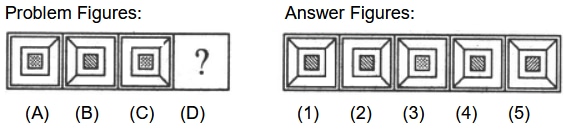
Each of the following questions consists of two sets of figures. Figures A, B, C and D constitute the Problem Set while figures 1, 2, 3, 4 and 5 constitute the Answer Set. There is a definite relationship between figures A and B. Establish a similar relationship between figures C and D by selecting a suitable figure from the Answer Set that would replace the question mark (?) in fig. (D). Select a suitable figure from the Answer Figures that would replace the question mark (?).
- A.
1
- B.
2
- C.
3
- D.
4
- E.
5
Attempted by 52 students.
Show answer & explanation
Correct answer: A
Concept: This is a figure-analogy question (A is to B as C is to D). First work out the single transformation that turns Figure (A) into Figure (B) by tracking two things separately: (i) which corners of the outer square carry a slanted connector to the middle square, and (ii) how the innermost square's shading changes. Then apply that exact same transformation to Figure (C) to get Figure (D).
Figure (A): only the top-right corner carries a slanted connector between the outer and middle square; the innermost square has criss-cross (grid) shading.
Figure (B): the connector set has moved one corner anti-clockwise (top-right to top-left) and gained one more connector one step further anti-clockwise (bottom-left), so two corners - top-left and bottom-left - now carry connectors; the innermost shading has toggled to slanting-line hatching.
Figure (C): the connectors sit at the top-right and bottom-right corners (the right side), and the innermost shading is back to criss-cross (grid).
Applying the same rule to Figure (C): shift its two connectors one corner further anti-clockwise (top-right to top-left, bottom-right to top-right) and add one more connector one step further anti-clockwise still (bottom-left). Figure (D) must therefore carry connectors at the top-left, top-right and bottom-left corners (leaving only the bottom-right corner as a plain right angle), with the innermost shading toggled to slanting-line hatching.
Cross-check: Figure (1) is the only Answer figure that has connectors at exactly the top-left, top-right and bottom-left corners together with slanting-line innermost shading, so it satisfies both the corner-progression rule and the shading-toggle rule at the same time.
Why the other Answer figures do not fit:
Figure (2): keeps only two connectors, both on the right side, exactly as in Figure (C), so the pattern is not carried forward.
Figure (3): keeps two connectors on the left side and reverts the innermost shading to criss-cross instead of toggling it.
Figure (4): repeats the two-corner left-side layout already used for Figure (B) instead of extending it by one more corner.
Figure (5): does extend to three connectors, but continues in the clockwise direction instead of anti-clockwise, so its connector positions do not match how Figure (C) should transform.
Hence Figure (1) replaces the question mark in Figure (D).