Select the alternative which represents three out of the five alternative…
20262024
Select the alternative which represents three out of the five alternative figures which when fitted into each other would form a complete square.
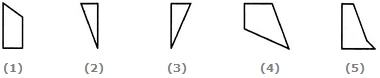
- A.
123
- B.
125
- C.
234
- D.
245
Attempted by 35 students.
Show answer & explanation
Correct answer: C
In a figure-reconstruction (assembling) question, an outline is divided into regions by straight internal cuts; the correct set of options is exactly the pieces whose own side lengths and angles reproduce those regions, without any gap or overlap — matched by actual shape, not by appearance alone.
Here the square is cut by two straight lines that both start from its bottom-right corner: one line meets the top edge roughly two-thirds of the way across, and the other meets the left edge close to its middle. These two cuts split the square into three regions — a narrow right triangle in the top-right (a short piece of the top edge and almost the full right edge as its two straight sides), a broad, low right triangle along the bottom (a short piece of the left edge and the full bottom edge as its two straight sides), and a quadrilateral covering the rest, with a right angle at the top-left corner, straight top and left sides, and its remaining two sides tapering to the single point where the two cuts meet.
Figures (2) and (3) are right triangles whose shorter side is close to two-fifths of their longer side, with the longer side running the full height of the figure — matching the two triangular regions. Figure (4) is a quadrilateral with exactly one right-angled corner, straight top and left sides, and its other two sides tapering cleanly to a single point — matching the third region.
Figure (1) has right angles at BOTH its lower corners (a trapezoid outline) — a piece produced by two straight cuts meeting at one point can only carry a single right angle, so figure (1)'s second right angle rules it out.
Figure (5) looks similar to the needed quadrilateral, but its long slanting side bends partway down instead of running as one continuous straight line — a straight cut cannot leave a kinked edge, so figure (5) is ruled out too.
So the only combination that reconstructs the square with no gaps or overlaps is figures (2), (3) and (4).