Select the alternative which represents three out of the five alternative…
2024
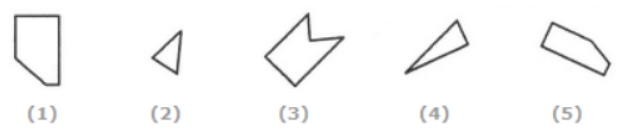
Select the alternative which represents three out of the five alternative figures which when fitted into each other would form a complete square.
- A.
124
- B.
125
- C.
234
- D.
245
Attempted by 48 students.
Show answer & explanation
Correct answer: B
Concept: In a shape-construction (assembling figures) problem, three of the five given pieces must join edge-to-edge, with no overlap and no gap, to exactly form the target figure - here, a square. This is only possible when matching edges between pieces are equal in length and shape, and when none of the chosen pieces has an unmatched concave notch or an oddly long, unmatched edge that the others cannot complement.
Application: Shape (1) is a large quadrilateral that forms most of the square, with one corner cut away along a single straight diagonal. Shape (2) is a small triangle whose two shorter sides match the two sides of that missing corner exactly, so it slots neatly into the cut-away corner. Shape (5)'s long edge matches shape (1)'s tall side, and its remaining short edges continue the boundary in a straight line. Joined this way, shapes (1), (2) and (5) enclose one continuous square boundary with no gap or overlap.
Cross-check: Shape (3) has an inward notch (a concave corner); none of the other pieces offers a matching outward tab of the right size to fill that notch, so any set that includes shape (3) always leaves a gap. Shape (4) is an extremely thin, elongated sliver whose one long edge has no equal-length partner among the remaining edges of the other pieces, so it can never close flush against them - it leaves either a sliver-shaped gap or forces an overlap. Therefore only shapes (1), (2) and (5) - option (125) - fit together to form a complete square.