Select the figure that will replace the question mark (?) and continue the…
2026
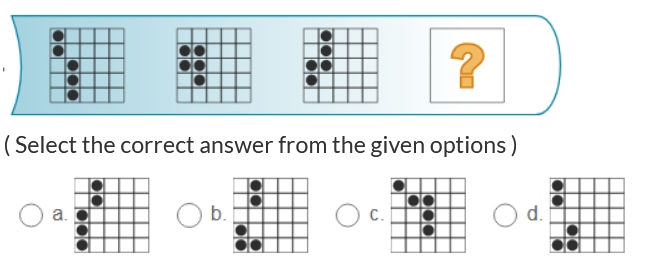
Select the figure that will replace the question mark (?) and continue the series.
- A.
a
- B.
b
- C.
c
- D.
d
Attempted by 41 students.
Show answer & explanation
Correct answer: B
Concept: In a vertically-moving dot-block series, each distinct cluster of dots behaves as a rigid block that shifts by a fixed number of rows in a fixed direction on every step; once a block reaches the top or bottom edge of the grid, it continues the same shift by wrapping around to the opposite edge, while its direction and step-size stay unchanged.
Application:
There are two blocks in the grid: a 2-dot block in the left column and a 3-dot block in the right column.
Left block across the first three frames: rows 1-2, then rows 2-3, then rows 3-4 — it shifts down by exactly one row every step.
Right block across the first three frames: rows 3-4-5, then rows 2-3-4, then rows 1-2-3 — it shifts up by exactly one row every step.
Applying the same shifts once more: the left block moves down one more row to rows 4-5 (still inside the grid). The right block moves up one more row; since it already sits at the very top (row 1) in the third frame, moving up wraps it to the bottom edge, so it ends up with dots in the top two rows and one dot in the bottom row of that column.
This exact combination — the left column filled in the bottom two rows, and the right column filled in the top two rows plus the bottom row — matches exactly one of the four given figures: the one with dots at rows four and five in its left column, and dots at rows one, two, and five in its right column.
Cross-check: Track just the top-row index of each block across the frames. The left block's top row goes 1, 2, 3 (increasing by 1 each step); one more step gives 4, i.e. rows 4-5 — confirmed. The right block's top row goes 3, 2, 1 (decreasing by 1 each step); one more step would give 0, which does not exist on a 1-5 row grid, so it wraps to row 5 while keeping rows 1-2 from the top — confirmed. Both independent checks land on the same figure.