Choose the figure which is different from the rest. (1) (2) (3) (4) (5)
2025
Choose the figure which is different from the rest.
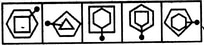
(1) (2) (3) (4) (5)
- A.
1
- B.
2
- C.
3
- D.
4
- E.
5
Attempted by 28 students.
Show answer & explanation
Correct answer: C
In a find the different figure classification question, four figures always share one consistent construction rule, and the answer is the single figure that breaks it. The safest way to find the rule is to compare a structural feature - not just which shapes are used - across every figure, such as exactly where the connecting line/dot meets the outermost shape: at a corner (vertex) where two straight edges meet, or in the middle of a flat side.
Figure 1 - outer hexagon with an inner square: the connecting dot's line meets the outer hexagon exactly at a corner, where two edges meet.
Figure 2 - outer pentagon with an inner triangle: the connecting dot's line meets the outer pentagon at a corner.
Figure 3 - outer square with an inner hexagon: the connecting line comes out of the middle of the square's bottom edge. A square's corners sit only at its four right-angle points, so this location is not a corner at all.
Figure 4 - outer hexagon, a middle hexagon, and an inner square: the connecting dot's line meets the outer hexagon at its bottom corner.
Figure 5 - outer hexagon with an inner hexagon: the connecting dot's line meets the outer hexagon at its right corner.
Checking corner-by-corner confirms it: a square only has corners at its four right angles, never at the midpoint of a side, so the line in the square-outer figure necessarily lands on a flat edge. Every other figure's connecting line lands exactly on one of the outer shape's corners, regardless of which inner shape (square, triangle, or hexagon) sits inside it - so the identity of the inner shape is not the governing rule; the vertex-vs-side attachment is.
Only the figure with the outer square breaks the shared vertex-attachment rule, so it is the odd one out.