A person starts walking from a point A towards South for 100 meters and turns…
2025
A person starts walking from a point A towards South for 100 meters and turns left to walk 40 meters East. Then, he again turns left to walk 60 meters towards North and turns left to walk 70 meters towards West to reach the point B. Then, the distance between the points A and B is (in meters):
- A.
90 m
- B.
70 m
- C.
60 m
- D.
50 m
Attempted by 2 students.
Show answer & explanation
Correct answer: D
Concept: When a person's path consists of straight-line segments along the four cardinal directions, the shortest (straight-line) distance between the start and end points is found by resolving the total movement into two perpendicular components — the net North–South displacement and the net East–West displacement — and then applying the Pythagorean theorem, since these two net components are the perpendicular legs of a right triangle whose hypotenuse is the required distance.
Applying this to the given path:
From A, he walks South 100 m.
He turns left and walks East 40 m.
He turns left again and walks North 60 m.
He turns left again and walks West 70 m to reach B.
Net vertical (South–North) displacement = 100 m South − 60 m North = 40 m South.
Net horizontal (East–West) displacement = 70 m West − 40 m East = 30 m West.
These two net displacements are perpendicular to each other, so they form the legs of a right triangle with AB as the hypotenuse.
By Pythagoras' theorem: AB = √(402 + 302) = √(1600 + 900) = √2500 = 50 m.
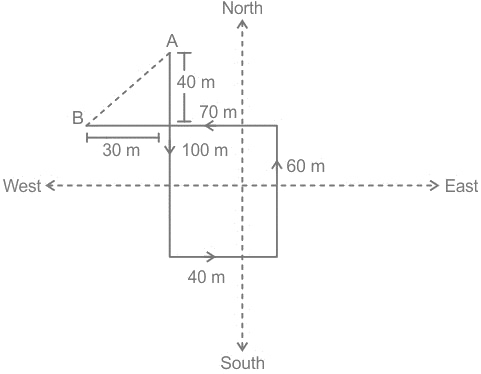
Cross-check: 40, 30, 50 form a Pythagorean triple (a 3–4–5 triangle scaled by 10), confirming that the computed hypotenuse is consistent with the two perpendicular legs.