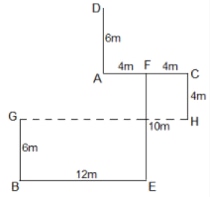
Eight persons are sitting at different places such that D is 6m north of A,…
2024
Eight persons are sitting at different places such that D is 6m north of A, who is 8m west of C. E is 12m east of B, who is 6m south of G. H is 4m south of C. F is 10m north of E. F is exactly between A and C. What is the shortest distance between G and H?
- A.
15m
- B.
16m
- C.
18m
- D.
20m
Attempted by 1 students.
Show answer & explanation
Correct answer: B
Direction-and-distance puzzles are solved by mapping every relation onto a compass-aligned coordinate grid: fix one point as the origin, let north add to the vertical (y) coordinate and east add to the horizontal (x) coordinate (south and west subtract). Once every point's (x, y) position is fixed from the given movements, the distance between any two points follows directly — and when two points share the same y-coordinate (or the same x-coordinate), the shortest distance between them is simply the absolute difference along the other axis, with no need for the Pythagorean theorem.
Fix A at the origin: A = (0, 0).
A is 8 m west of C, so C = (8, 0).
D is 6 m north of A, so D = (0, 6).
F is exactly between A and C, so F is their midpoint: F = (4, 0).
F is 10 m north of E, so E = (4, -10).
E is 12 m east of B, so B = (4 - 12, -10) = (-8, -10).
B is 6 m south of G, so G = (-8, -10 + 6) = (-8, -4).
H is 4 m south of C, so H = (8, 0 - 4) = (8, -4).
G = (-8, -4) and H = (8, -4) share the same y-coordinate (-4), so they lie on the same horizontal line. The shortest distance between them is simply the horizontal gap: |8 - (-8)| = 16 m.
Cross-check from the figure: the horizontal band from G to H runs below the A-F-C line, spanning B to E (12 m) and continuing across F to C's width (4 m), which again totals 12 + 4 = 16 m — confirming the coordinate derivation.